
















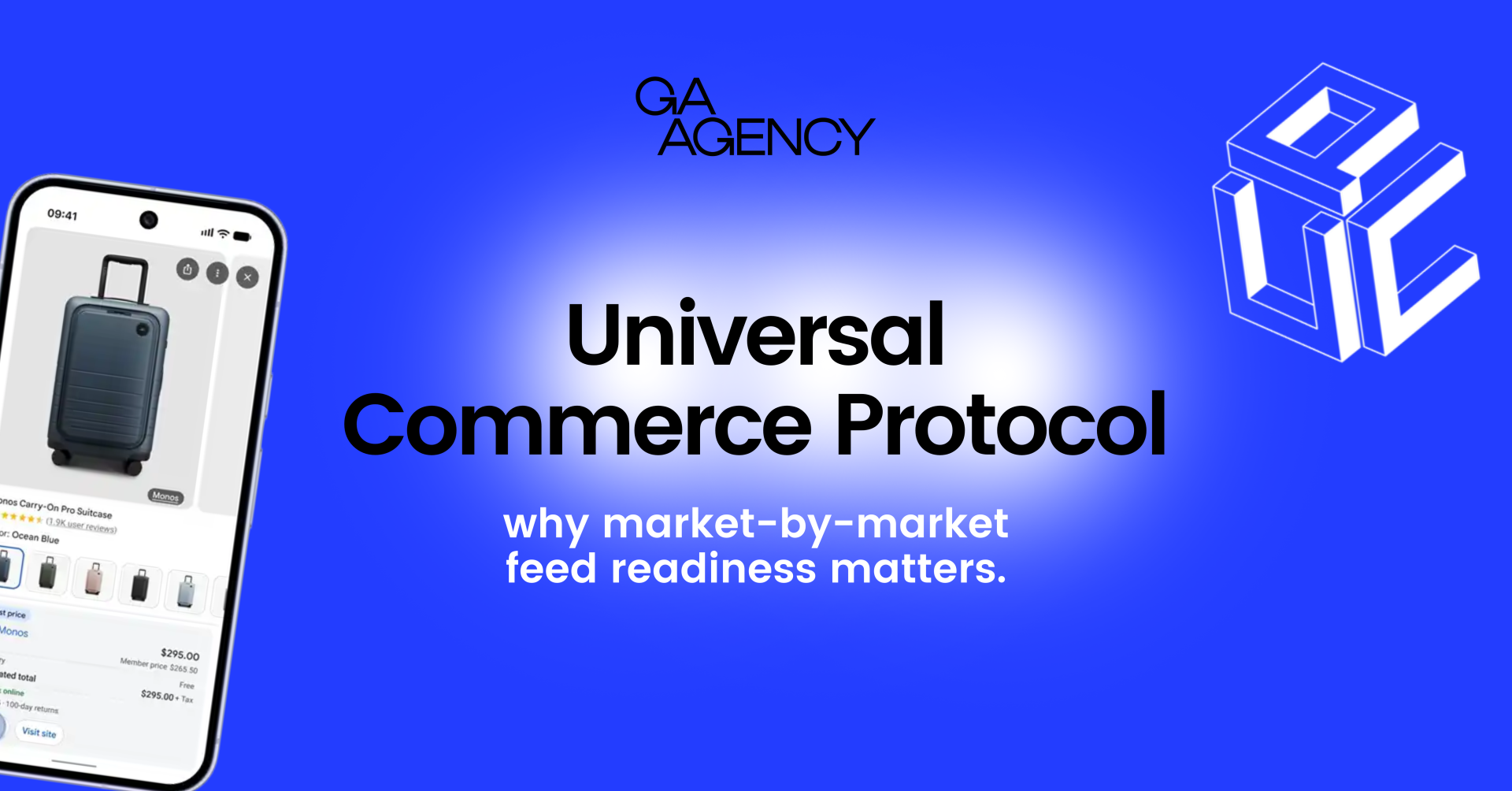
Google’s Universal Commerce Protocol is moving from announcement to infrastructure. At Google Marketing Live in May, Google expanded UCP with new checkout, shopping and payment features. It was also confirmed the rollout order: many UCP-powered features are launching in the US first, with expansions planned for Canada, Australia and later Europe.
For an EMEA-based brand, that sequence allows for some breathing room, however it is better to treat it as a deadline with a specific date attached. UCP changes what a product feed has to do and it will eventually do so in every market a brand sells in. Being near the back of the geographic queue gives the preparation window, and it closes market by market.
The brands that benefit quickest will be the ones whose product data was already accurate and consistent enough, in each market, that an AI agent was willing to transact on it.
What actually changed
For years, the Merchant Center feed has been a discovery file: a list good enough to surface a product and send a shopper to the site to buy. UCP changes that. It is an open, vendor-agnostic standard, co-developed with Shopify and endorsed by more than 20 partners, that gives AI agents and merchant systems a common language for discovery, pricing, availability and checkout. Through it, a customer can complete a purchase directly inside Google’s conversational surfaces, AI Mode in Search and Gemini, without visiting the brand’s site.
Two details matter for what brands should do now. First, the checkout is gated at the product level: only listings using the native_commerce product attribute show the “Buy” button in that experience, and the feature is currently open to selected US merchants. Product readiness is decided line by line, not catalogue-wide. Second, the brand stays the merchant of record, retaining the customer relationship and the ability to preserve its own checkout requirements. This is not Google taking over the sale. It is Google putting the brand’s own data in front of an agent and asking whether it is good enough to sell on.
Google’s own preparation advice is revealing: ensure all Merchant Center data (from product feeds to brand assets) is as robust and up to date as possible, and configure shipping, returns and product information so users can discover and buy. The work is data quality, and it is the same work in every market.
Why this should be on your agenda
The feed that sells at home will not automatically sell abroad
Pricing, currency, tax treatment, availability, shipping, returns terms and product attributes all vary by market. An agent completing a purchase in one market reads that market’s data and the checkout only appears for products whose data supports it. A catalogue that is checkout-ready in the home market tells you very little about whether it is ready in the others. For a brand operating across 10 or 20 markets, UCP readiness is not one project. It is the same data project repeated, with different inputs, in each market.
Consistency is now a condition of the sale, not a tidiness exercise
Google’s guidance points to the same foundations across the board: complete, accurate feeds, and shipping and returns information configured correctly. A human shopper might proceed past a price that does not match between the product page and the feed, or a missing returns policy. An agent deciding whether to surface a “Buy” button has no reason to. When the feed was for discovery, an inconsistency cost a little visibility. When the feed carries the checkout, the same inconsistency can stop the sale appearing at all and it has to hold true in every market separately.
Machine-translated feeds become a liability
The common shortcut for a new market is to translate the home feed and ship it. Under UCP that shortcut carries more risk than it used to. Product information that is translated without local commercial accuracy can misrepresent an offer or fail to match how buyers in that market describe what they want. The gap between translation and genuine local relevance has always affected visibility. UCP raises the stakes, because the data now sits between the product and the purchase, not just the product and the click.
What to do about it
Use the US-first sequence as your timeline. The UK and much of EMEA sit later in the rollout. Treat the months before UCP reaches your markets as the window to get every feed ready, rather than auditing them all under pressure once checkout goes live.
Reconcile product data market by market. For each market, confirm that price, availability, shipping and returns agree across your site, your Merchant Center feed and your major third-party listings. Look for contradictions, not just empty fields.
Treat native_commerce as a phased, per-market decision. Identify the products whose data is genuinely checkout-ready in a given market and prioritise those. Let the gaps become the to-do list for the rest.
Verify local feeds rather than trusting the translation. Check that titles, attributes and descriptions are accurate and commercially relevant in each language and treat machine-translated feeds as something to confirm market by market.
The brands that participate first in agentic commerce will be the ones whose product data is accurate, consistent and locally credible enough, everywhere they sell, that an AI agent will transact on it. If you want to understand whether your data is ready across the markets you operate in, get in touch with us today.
Sources
- Google Developers Blog, ‘Under the Hood: Universal Commerce Protocol (UCP)’ (11 January 2026)
- Google Merchant Center Help, ‘About the Universal Commerce Protocol (UCP) and UCP-powered checkout feature on Google’
- Google Merchant Center Help, ‘How to onboard to the Universal Commerce Protocol in Merchant Center’
- Search Engine Land, ‘Google expands Universal Commerce Protocol and launches new agentic shopping tools’ (20 May 2026)