



















What is the best website structure for multi-market and multilingual businesses?
It’s a question we hear often, especially when it comes to setting up global e-commerce websites.
Do you choose ccTLDs? Even for 10+ markets? Or do you choose gTLDs with subdirectories? Perhaps even subdomains? (“No! Never subdomains!” I hear you all shout.)
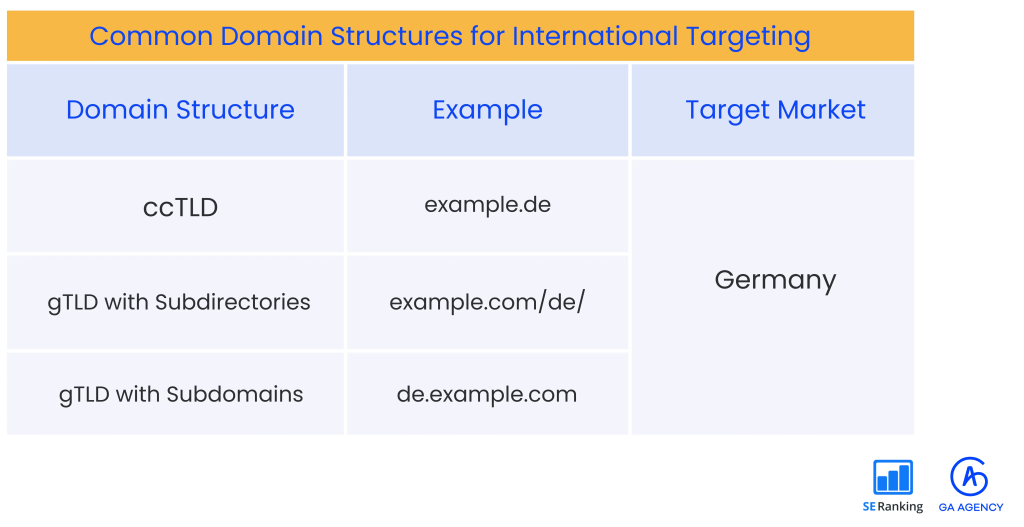
Here’s a quick recap of domain structures for international seo strategies:
We all have our preferences in international seo services. And we have Google’s recommendations.
SEOs have debated the use of subdomains or subdirectories for years. And there have been plenty subdomain vs subdirectory case studies as well.
But we wanted to do some research to see if there is any hard evidence for which website structure to choose.
So, let’s get into it.
Global Results
1. 56% of the top three positions are held by ccTLDs
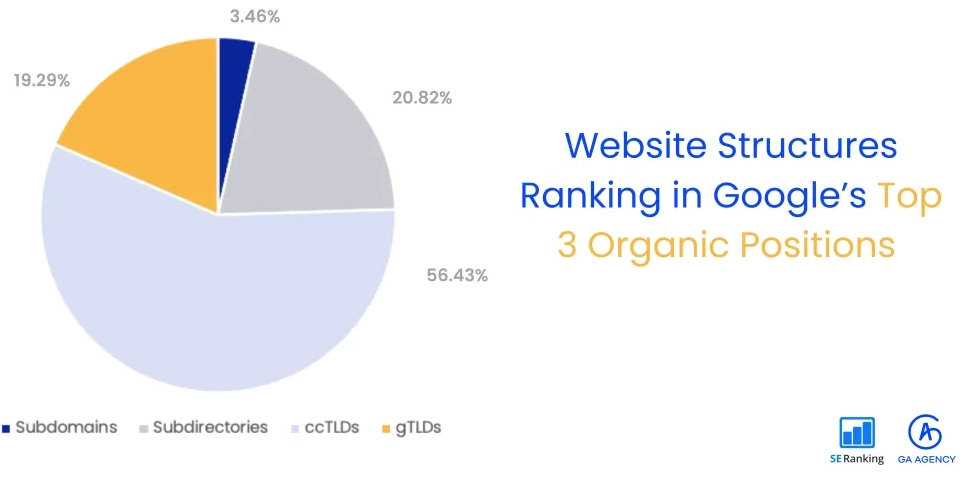
This data reveals that ccTLDs are the most prevalent website structure found in the top three ranking positions globally. This will come as no real surprise, as we know ccTLDs are one of the strongest localisation signals we can provide to Google.
However, ccTLDs come with some downsides when you are targeting multiple locales. They can be expensive and inefficient to manage. But if you have the resources to optimise multiple ccTLDs well enough, this data suggests it could be your best approach.
2. The prevalence of ccTLDs and gTLDs in SERP positions are inversely correlated
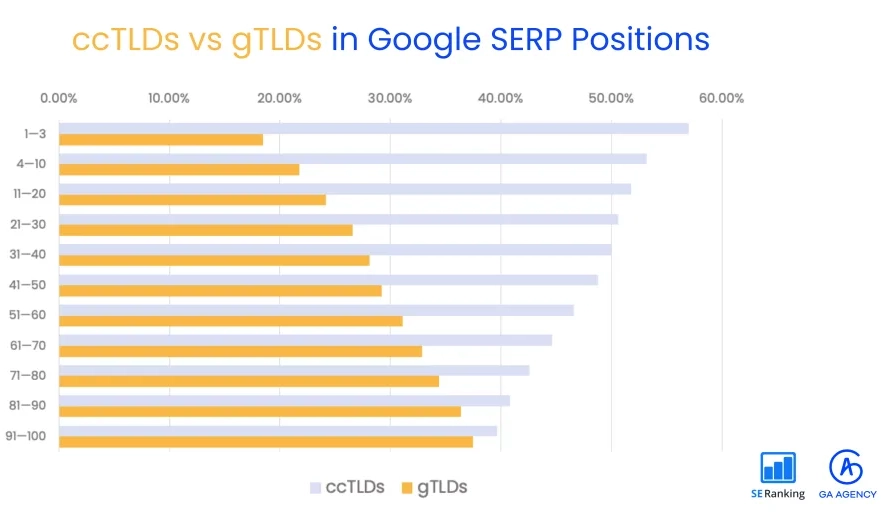
Perhaps the most interesting result from this analysis is the inverse correlation between ccTLDs and gTLDs. Does this suggest Google’s algorithm is playing a part here? Or is it just a coincidence that they inversely related so closely?
It’s hard to say. But it’s clear that globally gTLDs are most prevalent in positions 91—100 and they decrease in prevalence towards the top three positions.
3. Subdirectories are the second most prevalent website structure in the top three positions
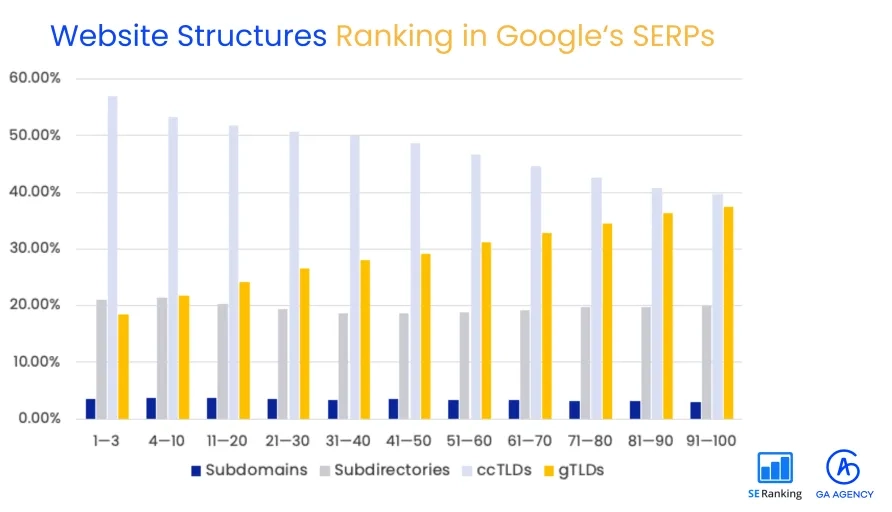
Subdirectories are often the best option for international brands targeting multiple locales (especially when you cannot justify ccTLD investment in every market you want to target). For instance, it is well established that subdirectories will benefit more from the domain’s authority compared to subdomains.
4. Subdomains account for just 3% of domain structures in SERPs and are only prevalent in top positions in multilingual markets
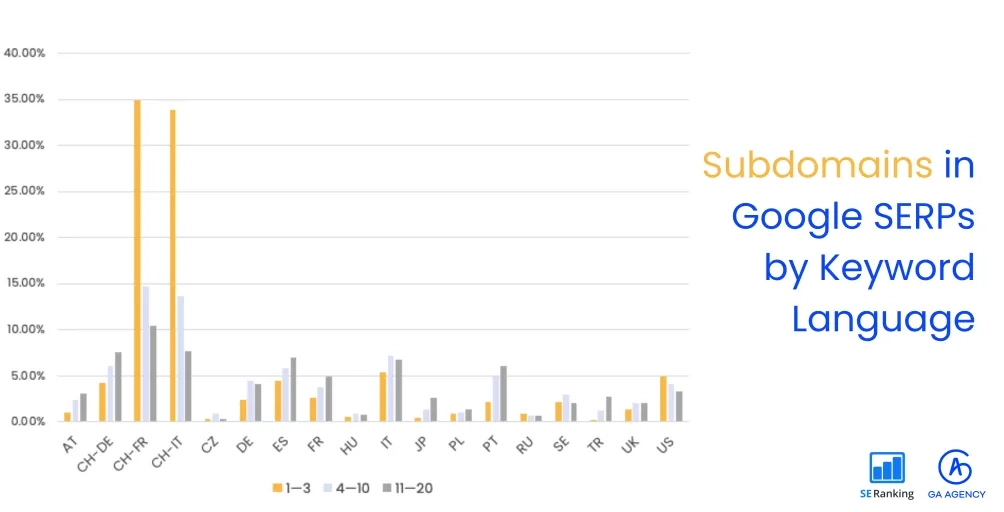
The fact that subdomains are reasonably prevalent in Switzerland for French (CH-FR) and Italian (CH-IT) language keywords does suggest they can be used well. However, it is clearly uncommon to see subdomains when analysing primary market languages.
Individual Market Insights
1. Swiss ccTLD appears most prevalently for German language keywords, while for Italian keywords in Switzerland, subdirectory use is most common.
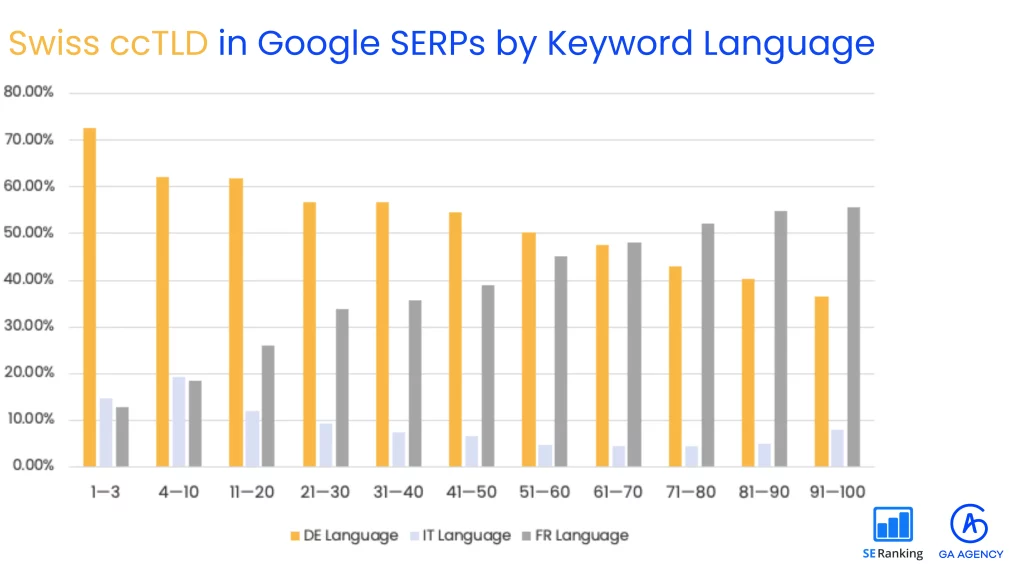
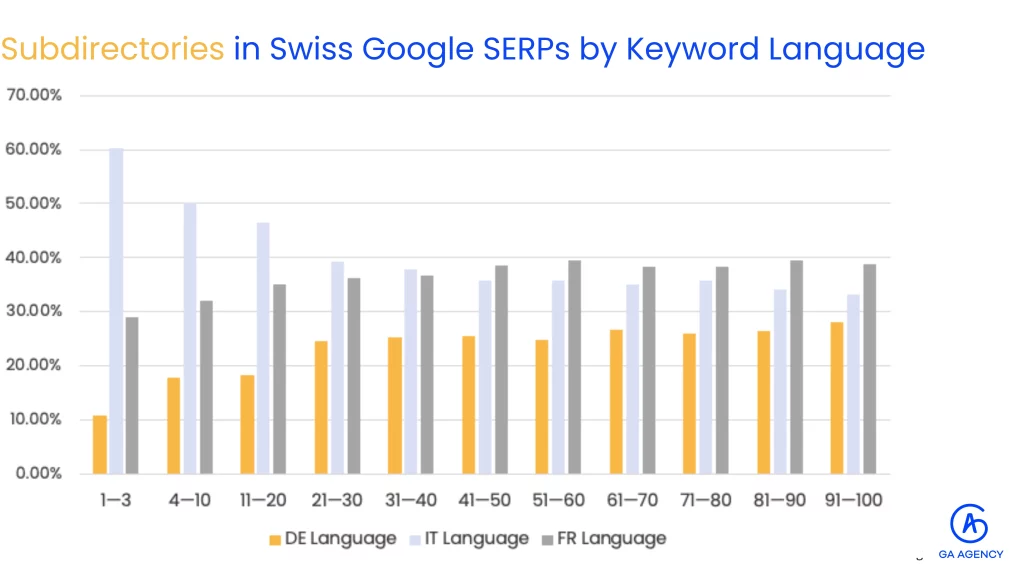
German is the most commonly spoken language in Switzerland, so it makes sense that the CH ccTLD structure is most prevalent when searching in this language. Interestingly, despite being the second most common language, the CH ccTLD is least prevalent for French keywords.
“When it comes to multi-language markets such as Switzerland, it’s important to make sure users can easily navigate between locales once they land on your website. On several brands we work with, we see users regularly moving from French, German, and Italian market content onto the Swiss content. For example, users may live in Switzerland but have entered your site via an Italian link, or vice-versa.”
Clelia Monti – CH Market Lead
2. Portugal is the only market where subdirectories are more common in the top three positions than ccTLDs
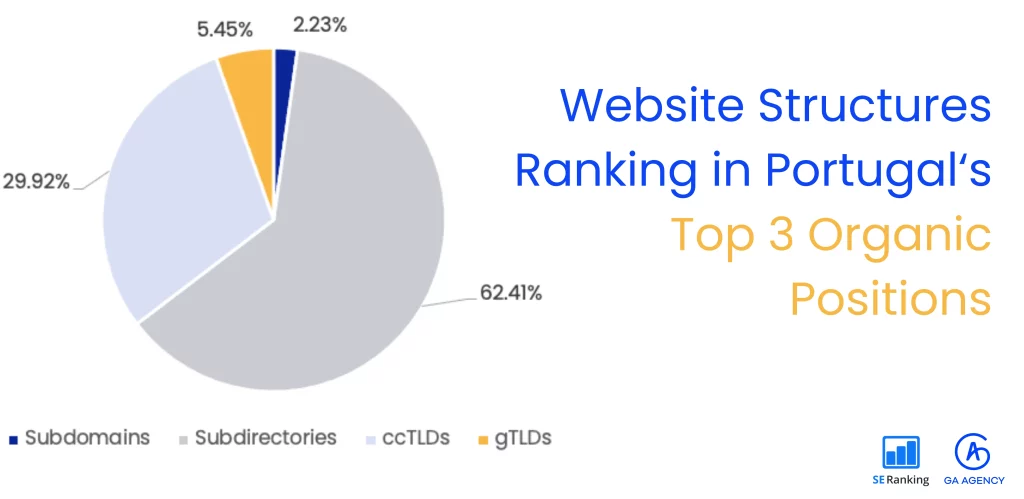
Portugal bucked the trend and is the only market where subdirectories are more commonly ranking in the top three positions than ccTLDs.
“This data reflects the fact that there aren’t many very big Portuguese brands who are able to compete with multi-national brands who are using subdirectory structures. For example, brands like Pull and Bear, Zara, and Calzedonia all perform incredibly when it comes to fashion keywords with subdirectory structures.”
Filipa Silva – PT Market Lead
3. Czechia has the highest rate of ccTLDs in Google SERPs
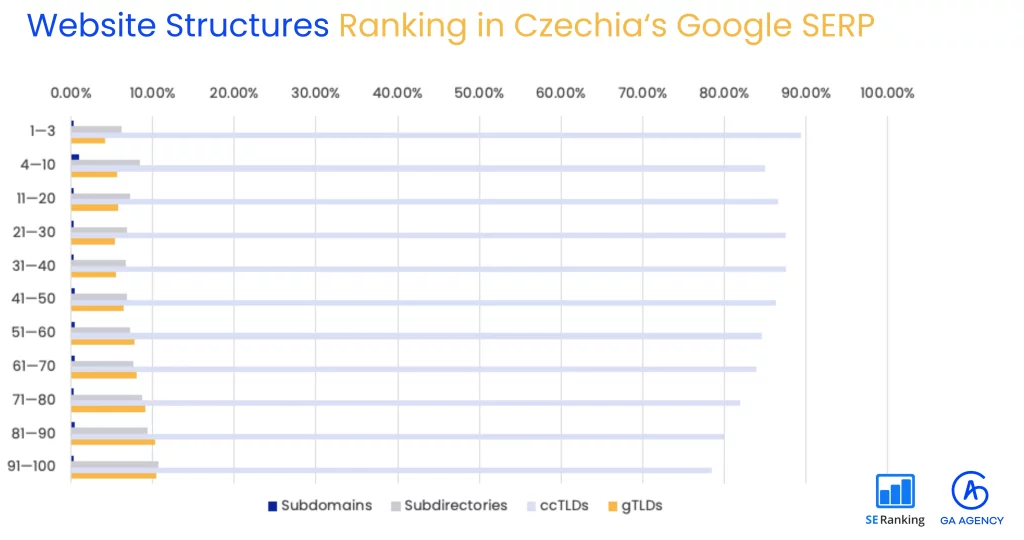
Of all countries analysed, Czechia (Czech Republic)’s SERPs are dominated by ccTLD website structures.
“I notice that many big brands tend to either choose not to translate their content into the Czech language or use poor translation services which we can see right through. And this is such a shame, suggesting that there is a big opportunity for multi-national brands to translate their content better into an optimised format for the Czech market.”
Iryna Melnyk – CZ Market Lead
4. In Austria, .AT ccTLDs inversely correlate with German ccTLDs
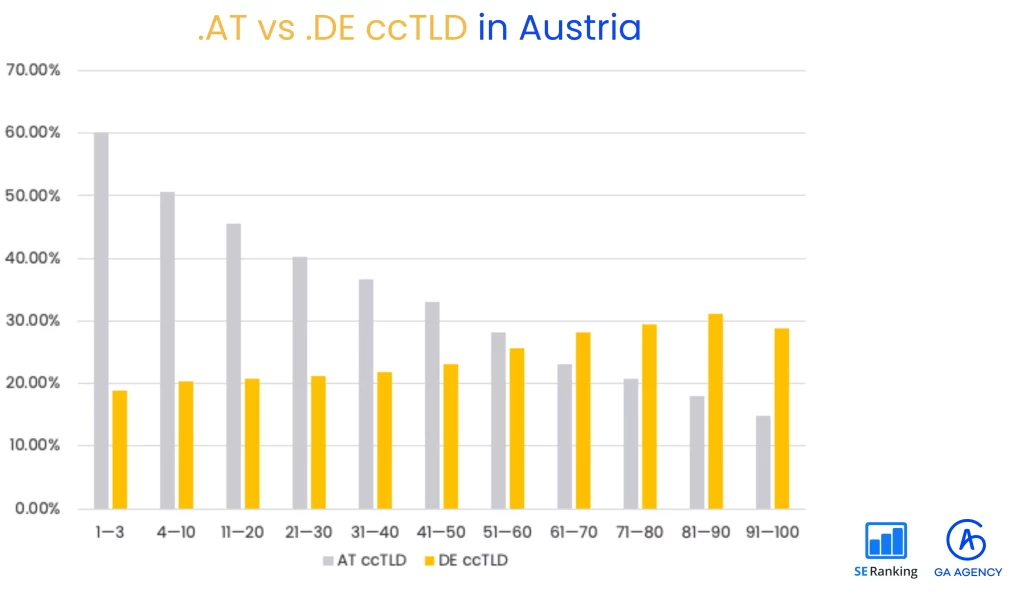
In Austria, German ccTLDs account for almost 20% of all top positions and there is evidence of inverse correlation between the two. By contrast, we found just three Austrian ccTLDs in the top three positions of German SERPs where Austrian ccTLDs make up less than 1% of all domain structures.
“Given the size of the populations and their economies, this data comes as no surprise in general. Lots of German brands sell directly into Austria via .DE domains, but there are nuances in language and we’d always recommend localising content into an Austrian dialect as best practice.”
Tatjana Batjaev – DACH Team Lead
5. The popularity of .com means the US is a statistical anomaly for gTLD use
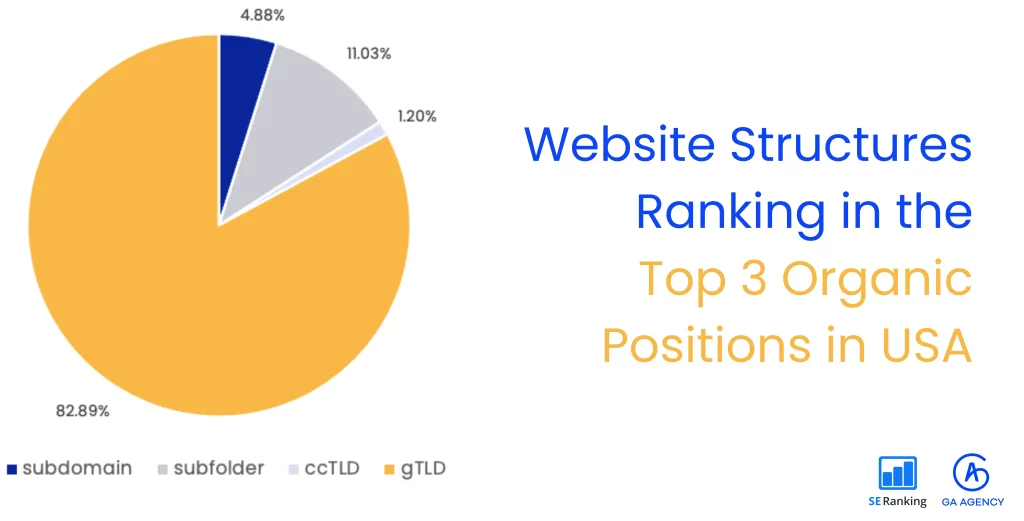
This statistical anomaly is undoubtedly due to the overwhelming popularity of the .com domain in the US market. It is very rare to see the official .us ccTLD in use.
“.com domains are ubiquitous in the US market, and many people just assume .com is USA’s ccTLD. Given how popular it is, it is probably the only market where we would ever recommend using a gTLD (.com) ahead of the country’s ccTLD when advising brands who are only targeting the US market.”
Melina Lyraki – US Market Lead
What Have we Learnt?
Globally, ccTLDs account for most top-ranking positions in each country. And that makes sense – ccTLDs are one of the strongest geo-location signals you can provide to Google.
But ccTLDs are not always an efficient way for businesses looking to target multiple markets. If you’re considering different options, subdirectory structures are popular and appear often in the top ranking positions on Google.
Subdomains are the least prevalent website structure in Google’s SERPs, but the analysis of the Swiss market does indicate that subdomains can be just as effective as subdirectories. The fact that subdirectories are more prevalent may simply reflect website owner preference rather than indicate subdomains are worse than subdirectories for SEO services.
gTLDs with no geo-location signals in the domain structure inversely correlate with ccTLDs in Google’s index, accounting for 40% of URLs in positions 91 – 100, but less than 20% of URLs in the top positions.
In addition, the inverse correlation found in Austria between .AT and .DE domain structures furthers our understanding of how Google treats ccTLDs in each market vs any other TLD.
As Google itself states, “[a ccTLD] tells us that the website is probably more relevant in the appropriate country”. That line, along with this data suggests Google tends to rank ccTLDs higher in each market than any other domain structure.
Methodology
- We worked with our partners at SE Ranking to analyse 20,000 keywords across 15 different markets, counting how often each website structure appears in each Google position from 1-100. In total, over 1.7 million SERP positions were analysed.
- We analysed ~1,400 keywords in each market.
- We looked at ccTLDs, gTLDs with subdomains, gTLDs with subdirectories and also gTLDs with no evidence of market specific subdomains or subdirectories.
- We did not include website structures using URL parameters in this study, as they are not recommended.
- We used transactional or purchase intent e-commerce keywords across all languages, with some variations depending on language nuances.
- Markets Analysed: AT, CH-DE, CH-FR, CH-IT, CZ, DE, ES, FR, HU, IT, JP, PL, PT, RU, SE, TR, UK, US
Notes on Categorisation
- If the URL has a subdirectory and a ccTLD, we counted it as a ccTLD only.
- If the URL has a subdomain and a ccTLD, we counted it as a subdomain only.
For example: it.intrend.it - If the URL has a subdomain and a subdirectory, we counted it as a subdomain only.
For example: pl.victoriassecret.com/pl/ - If the URL has no ccTLD, subdomain or subfolder corresponding to the market analysed, we considered it a generic gTLD.
About SE Ranking
We’d like to thank SE Ranking for helping us to produce this research.
SE Ranking is a robust SEO toolkit that best suits small to mid-sized agencies and in-house teams. It combines unique datasets with advanced features to help SEO pros build and implement effective strategies.
SE Ranking covers keyword and competitive research, on-page, off-page and technical seo optimisation, content creation, local SEO and more. Teams can benefit from automated reporting, WL, and the extra user seats included in most subscription plans.
As we can attest, SE Ranking’s pricing policy is generous and flexible.