

















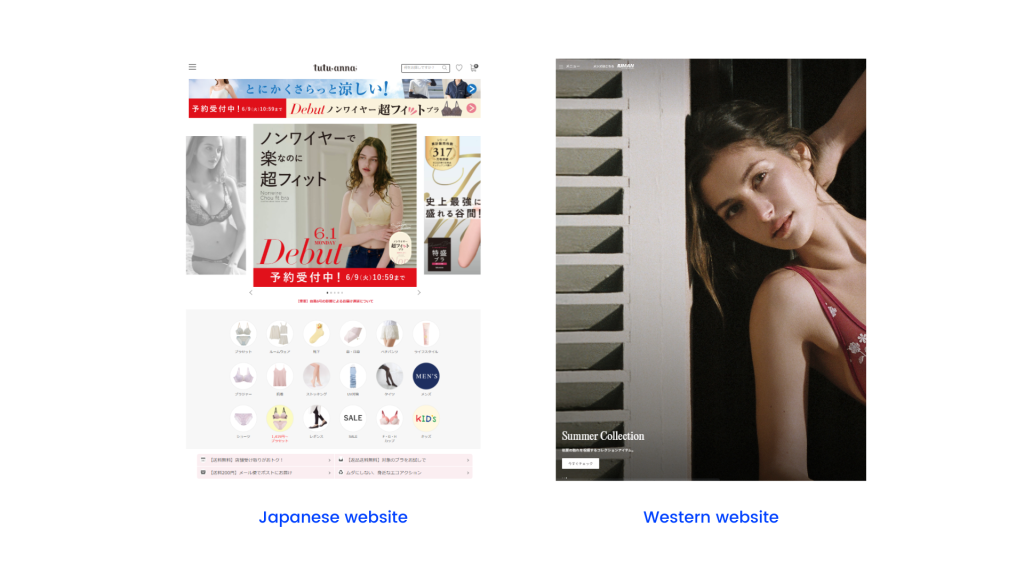
Show a Western marketer a typical Japanese fashion or beauty homepage and the reaction is fairly predictable: too many banners, too much text, no visual hierarchy. The western instinct is to simplify it, but following this instinct in the eastern world would be a mistake.
More than a taste story, this is a story about what happens when a brand assumes a market entry playbook that worked in Paris or New York will translate, with a language swap, to Tokyo or Osaka. It’s a read we’re offering from the inside: that’s what our own team on the ground in Japan keeps noticing.
The pattern our Japan market team keeps flagging
Density on a Japanese e-commerce site is a trust signal. Detailed, information-rich pages read as effort and credibility to Japanese consumers, where a minimal Western layout can read as unfinished or evasive. Our Japan market team describes it plainly: dense pages reassure – sparse ones raise questions.
The navigation logic is different too: Western users tend to be goal-oriented, they know what they want and go straight to the menu. Japanese browsing behaviour, on the other hand, is more discovery-oriented, closer to scanning a shop floor than executing a search. That’s why large, colourful banners consistently outperform top-menu navigation and why our Japan market team has observed that a well-placed mid-page banner often converts better than a link in the header, the opposite of what most Western UX conventions would predict.
The takeaway: a “cleaner” redesign, applied without local input, removes the very cues Japanese users rely on to trust a page.
Why it happens
This isn’t a stylistic accident. Japan scores 92 on Hofstede’s uncertainty avoidance index, high among developed economies, which tracks with a broader preference for detailed information, established rankings and social proof over minimal choices. It shows up in retail heritage too: Japanese e-commerce has long echoed the visual density of physical marketplaces and point-of-purchase advertising, rather than the gallery-style presentation common in Western retail.
Applying a Western framework here without checking whether the logic holds is where most localisation efforts go wrong. A page built to satisfy Google’s E-E-A-T signals for a UK audience is not automatically read as trustworthy by a Japanese one: the underlying trust cues are culturally specific, not universal.
What this changes for brands operating there
- Treat the Japan site as a market decision, not a translation task. Content adaptation should extend to information density, page length and navigation structure, on top of copy.
- Rebuild the trust architecture. Reviews, rankings, detailed specifications and social proof carry more weight in Japan. Removing them to “clean up” a page removes the mechanism that earns the click.
- Reassess where the budget goes. If a brand’s Japan strategy assumes the same search dynamics as its home market, the plan is built on the wrong data.
The overlooked data point
Most brands assume Google’s dominance is uniform worldwide: Japan is the clearest exception. In early 2025, Bing held under 8% of the Japanese search market. By April 2026, StatCounter put Bing at 36% of all-device search share in Japan, with Google down to 55% and Yahoo! Japan at 6%.
To put that in perspective, Bing is roughly eight times more popular in Japan than it is in the rest of the world. For international marketers, it’s clear proof that Japan is a completely different digital ecosystem.
The driver is Microsoft’s Copilot integration inside Edge, reinforced by preinstallation agreements with major Japanese device manufacturers. It’s a useful reminder that the same discovery-oriented and trend-following browsing behaviour showing up in Japanese web design also shows up in how the country adopts search platforms: fast and outside the assumptions most Western SEO planning is built on.
For any brand running paid or organic strategy in Japan on a Google-only assumption, that’s a meaningful blind spot.
The point that matters
Japan doesn’t reward brands for looking local. It rewards brands for understanding why local looks the way it does and building strategy on that logic rather than just importing. Get that right and the “cluttered” site stops looking like a compromise and starts looking like it was built to convert.
If you’re weighing whether your Japan presence reflects the market or just a translated version of your home site, that’s worth a conversation with our team.
Sources
- StatCounter, Search Engine Market Share Japan (accessed July 2026)
- SerpSculpt, Search Engine Statistics by Country
- Hofstede Insights / The Culture Factor Group, Country Comparison Tool — Japan
- Fujitsu Global, “When Clutter Got Purpose: Understanding the Role of Cultural Context in UX/UI”

Article author

Meiko Kato and Shiho Cumming
SEO Specialists
Bilingual Japanese SEO Specialists at GA Agency with international experience across the UK and Japan.