
















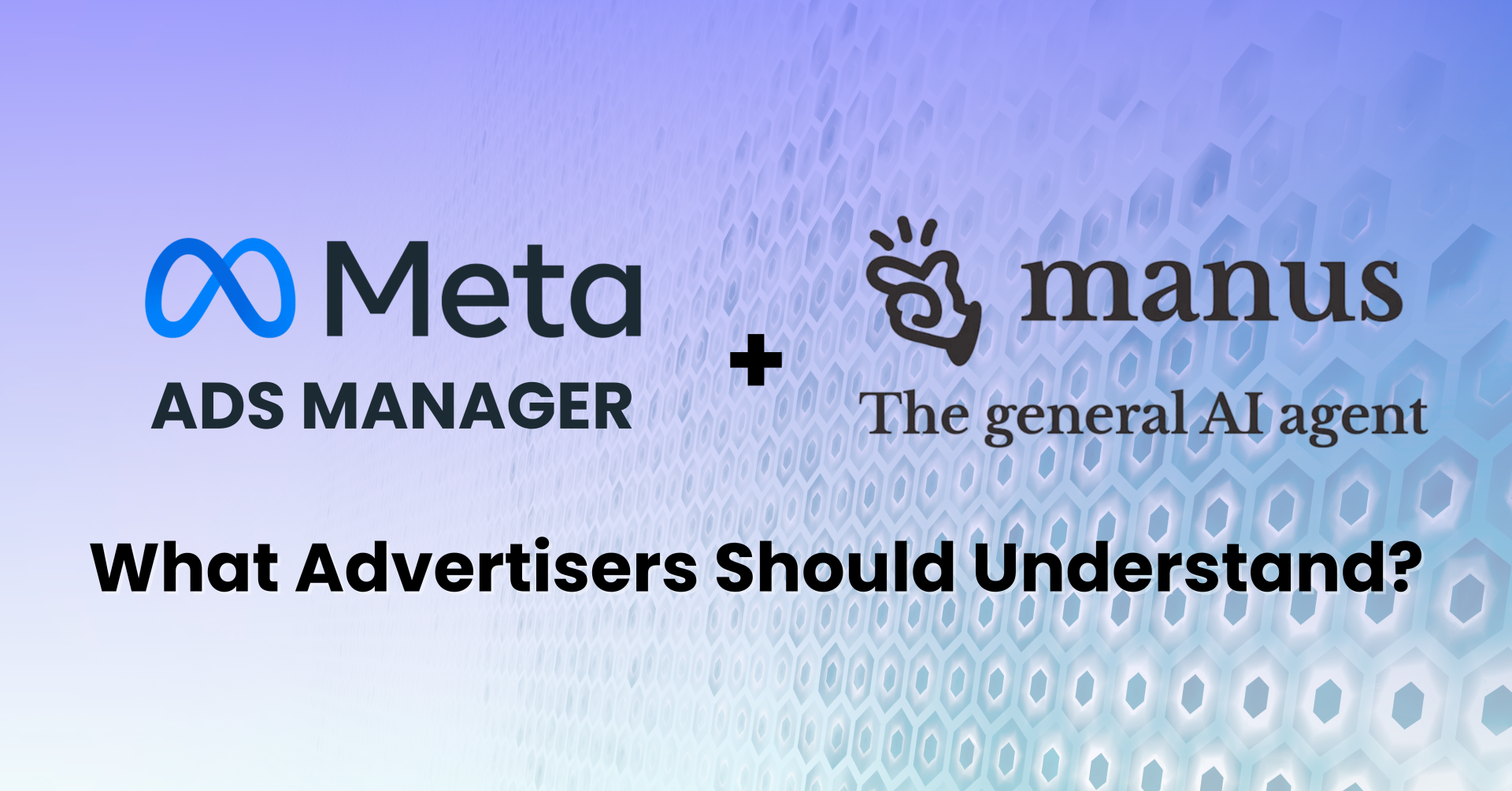
Meta has begun rolling out a deeper integration of Manus AI, its recently acquired AI agent technology, directly into Ads Manager, signalling a broader shift towards AI-assisted workflows in social advertising. Rather than a stand alone experiment, Manus is now visible within everyday advertiser tools and accessible via the platform’s “Tools” menu, even appearing as a pop up reminder directly in the campaign view.
This development comes amid Meta’s ongoing investment in AI capabilities, and it reflects a strategic focus on embedding automation where advertisers spend most of their time. In this article, we explain what Manus AI brings to the table and outline its implications for campaign management, optimisation and the role of media teams.
What Manus AI Is and How It Works
At its core, Manus AI is an autonomous AI agent, a technology designed to go beyond simple text generation to perform multistep operational tasks. Meta acquired Manus in late 2025 as part of a broader push to make AI a central part of its platform experiences.
Inside Ads Manager, Manus is positioned as a work assistant for advertisers. Instead of merely suggesting copy or providing surface-level insights, it can assist with tasks that typically require manual effort and specialised knowledge, such as:
- Generating campaign performance reports.
- Conducting audience research or segment analysis.
- Offering insights into creative and placement performance.
In practical terms, Manus is found in the “Tools” section of Ads Manager, with some advertisers also seeing in-workflow prompts that encourage early experimentation. Its presence alongside established features suggests that Meta anticipates AI assisted workflows becoming a routine part of campaign management.
Why This Matters to Paid Media Teams
1. Automation of Operational Tasks
On paper, one of the most immediately tangible benefits of Manus AI is its ability to automate repetitive or time-consuming workflows. Historically, advertisers and media planners have spent a significant part of their day generating reports, segmenting audiences and pulling performance metrics from multiple dashboards. Manus promises to streamline these tasks using natural language prompts, converting what were previously manual processes into conversational interactions with an AI agent.
For agencies and in-house teams, this can free up time for higher-value strategic work such as creative planning, messaging refinement, and budget strategy, areas where human judgement remains essential.
2. Implications for Campaign Insight and Optimisation
By centralising analysis and research functions, Manus may help teams identify patterns or opportunities they might otherwise overlook. For example, it can highlight performance anomalies or audience segments that warrant deeper investigation. This could help reduce reliance on external dashboards or manual spreadsheet analysis.
However, early testers have noted that Manus is still evolving in its ability to interpret complex ad data structures, and accuracy varies depending on the depth of campaign metrics and objective context.
Interpreting Early Adoption
As with any emerging tool, it is important to temper expectations. Manus is not yet a fully autonomous campaign manager, it does not replace strategic planning, nor does it currently create or modify live campaigns on behalf of advertisers. Instead, its current role is interpretive and generative: it helps advertisers make sense of data and explore possibilities more efficiently.
Early adoption insights from industry testing suggest mixed results. Some advertisers appreciate the speed and convenience of automated reporting and analysis, while others point to limitations around contextual understanding and interpretation of nuanced campaign dynamics.
This stage of development is characteristic of AI integrations across major ad platforms: tools become available while capabilities continue to expand incrementally, and real world experimentation helps shape how and where these technologies add the most value.
Strategic Takeaways for Marketers
Treat AI as an Assistant, Not an Operator
Manus is best viewed as an assistant for operational tasks, not as a substitute for human strategy. Advertisers should use it to handle data heavy work that would otherwise consume time, allowing teams to focus on judgement-driven decisions about creative, audience positioning and business goals.
Evaluate Insights, Don’t Default to Output
AI-generated insights need to be checked against business context and campaign objectives. Automated summaries and recommendations can accelerate insight gathering, but they should be interpreted alongside core performance metrics and stakeholder priorities.
Test Early, Monitor Results
For brands and agencies running Meta ads, as with all new releases, it makes strategic sense to test Manus within a controlled subset of workflows. Start with reporting and audience exploration where the ROI opportunity is clearest, and broaden usage based on observed accuracy and usefulness.
Looking Ahead
Meta’s deeper integration of Manus AI into Ads Manager signals a broader shift in how AI is embedded into advertising operations, moving from suggestive tools to task-focused agents that can streamline routine work.
While Manus will continue to evolve, its early incorporation into core workflows reflects an industry trend towards AI-assisted campaign operations. For paid media marketers, this underscores the importance of adapting not only to new formats and placements, but also to new work patterns where AI becomes a collaborative partner in optimisation and insight generation.
Get ahead of the curve, contact us!

Article author

Chiara Riva
Business Development Assistant