

















Peak season preparation has traditionally focused on the same priorities: forecasting inventory, confirming shipping cutoffs, load-testing the site and locking paid budgets by October.
All of that still matters, the difference in 2026 is that the path to purchase is changing too.
During the 2025 holiday season, traffic to US retail sites from generative AI tools increased 693% year on year, the largest increase Adobe recorded across industries. More importantly, that traffic converted 31% better than traffic from other sources. AI is becoming part of how shoppers discover, compare and evaluate products.
That creates a new question for Q4: is your site ready to handle peak demand and to be discovered within it?
Peak Season is getting bigger. So is the discovery challenge.
The scale of peak season continues to grow. Adobe Analytics recorded $257.8 billion in US online spending across November and December 2025. Black Friday reached $11.8 billion, up 9.1% year on year, while Cyber Monday reached $14.25 billion, up 7.1%.
Paid Media and organic visibility remain fundamental to capturing that demand. Increasingly, another factor sits alongside them: whether a brand’s content and product data can be understood and surfaced by the AI tools shoppers use during the research process.
US retail homepages were, on average, 75% readable by large language models, compared with 74% for category pages and just 66% for product pages. That means a significant portion of the pages closest to the purchase decision may not be fully accessible to the systems that are influencing product discovery.
For peak season, this matters because visibility now depends on more than ranking in a traditional search result.
SEO readiness still starts before peak
The fundamentals of seasonal SEO have not changed. The timing has become more important. Seasonal landing pages and gift-guide content need to be live and indexed before demand arrives. Google needs time to crawl, understand and rank new content. Site architecture and checkout performance also need to be tested under realistic peak conditions. Changes made in November are unlikely to deliver their full value in November.
The same principle applies across the site: peak season readiness is something to complete before peak traffic arrives.
GEO is becoming part of peak readiness
This is where traditional checklists are starting to fall short. If AI-referred traffic is converting at a higher rate than other sources, then product data and machine readability become part of the revenue equation.
Product titles, descriptions, pricing, availability and structured data all contribute to how products can be understood across digital discovery environments: a product page that an AI system cannot reliably interpret has less opportunity to be surfaced, even when its traditional SEO performance is strong.
That makes machine readability less of a standalone GEO project and more of a natural extension of technical and content readiness.
Paid Media needs preparation, not reaction
The same principle applies once shoppers move from discovery to acquisition.
Peak weeks bring higher competition and more expensive auctions. Performance Max campaigns need clear governance before that pressure arrives, while budget pacing needs to account for demand that can build well before Black Friday itself.
The campaigns that perform best during peak season are the ones that have already been tested, structured and given clear parameters beforehand peak season.
That means Paid Media readiness is about anticipating and reducing the number of decisions that need to be made in November.
One peak-readiness cycle – not three separate workstreams
SEO, GEO and Paid Media are often planned as separate activities. Peak season makes the connections between them harder to ignore.
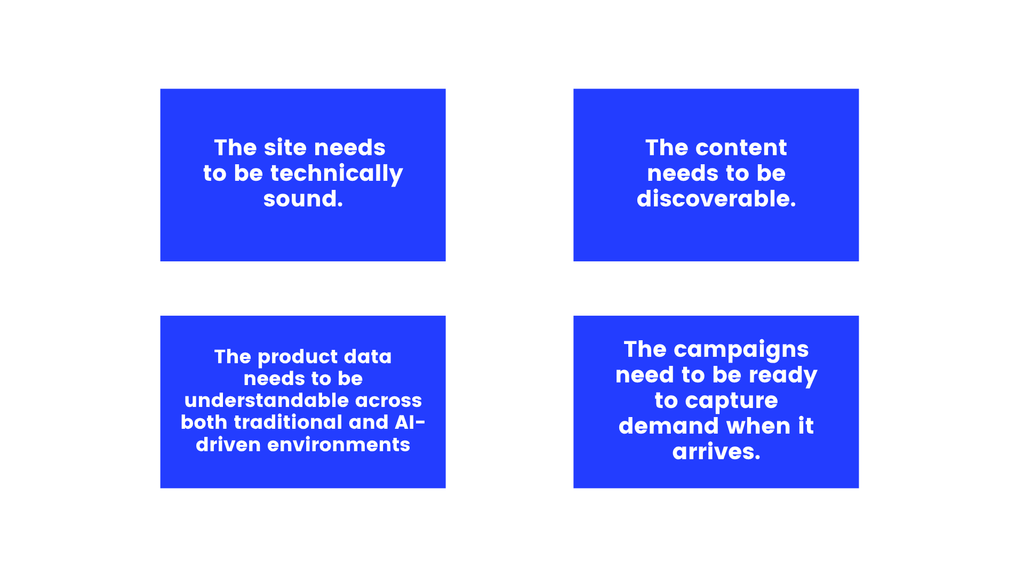
These are different disciplines, but they are working towards the same outcome: making sure shoppers can discover, evaluate and buy from your brand when demand is at its highest.
So what should retailers do now?
- Audit machine readability.
Review product and category pages for AI visibility, prioritising high-revenue stok keeping units (SKUs) where time for remediation is limited. - Treat product feeds as a shared SEO and GEO asset.
Accurate titles, descriptions, pricing and availability support both traditional shopping surfaces and emerging AI-driven commerce experiences. - Finish technical changes early.
Complete and stress-test anything affecting site architecture, checkout or performance well before peak traffic arrives. - Set Paid Media governance in advance.
Define Performance Max guardrails, budget pacing and escalation rules before auction pressure increases, so peak-week decisions can focus on execution rather than strategy.
All of these are different parts of the same preparation cycle and neither should be left for last minute.
Peak season 2026 is both about having enough inventory, budget or server capacity and about being visible, understandable and ready wherever shoppers are making decisions.
If you want to understand where your site currently stands across AI visibility, SEO and Paid Media readiness for Q4, that’s the conversation worth having before peak begins.
Sources
- Adobe Analytics, Holiday Shopping Season Drove a Record $257.8 Billion Online, January 2026 (https://news.adobe.com/news/2026/01/adobe-holiday-shopping-season)
- Adobe Analytics, AI-Driven Traffic Surges Across Industries, January 2026 (https://business.adobe.com/blog/ai-driven-traffic-surges-across-industries)
- Adobe Analytics, AI Traffic Grows But Retail Sites Lag in AI Search Visibility, April 2026 (https://business.adobe.com/blog/ai-traffic-surge-retail-sites-not-machine-readable)

Article author