

















When a campaign falls short of its objectives, the instinct is often to increase the budget or broaden the audience. But more reach does not always mean better results. Sometimes, the real opportunity lies in refining who you target and making sure your campaigns reach the companies that matter most to your business.
At GA, we explored this with our B2B clients on LinkedIn: by refining the targeting, we saw promising improvements in lead generation, traffic and cost efficiency over the course of a month. While further testing is needed to validate these early results, they offer a useful starting point for planning the year ahead.
For B2B marketers planning their 2027 LinkedIn strategy, here are three areas worth prioritising, informed by campaign insights, creative testing and a more considered approach to targeting.
Less targeting, better results? What our LinkedIn test revealed
The idea that less can be more sounds straightforward, but how does it translate into a practical marketing strategy?
At GA, we use testing to challenge assumptions and understand which changes can make a measurable difference. Consider a B2B client looking to generate more leads through a LinkedIn Lead Generation campaign. The instinct might be to broaden the audience to reach more potential prospects. Instead, we took a different approach: we refined the targeting strategy while keeping the creative and ad copy unchanged.
Specifically, we introduced company-level targeting, focusing delivery on a more defined set of organisations rather than relying solely on broader audience criteria. LinkedIn offers several professional targeting options, including company name, industry, company size, job title and seniority. Used together, these can help advertisers build an audience that reflects both the organisations they want to reach and the people involved in purchasing decisions. We then assessed performance using leads, traffic and cost per click as our main KPIs. Over a one-month period, the results were encouraging, with an increase in leads and conversion rate, with a corresponding reduction in cost per lead.
The test also reflects a principle highlighted in LinkedIn’s article The B2B Performance Principles: “Win the company, not the click.” B2B purchasing decisions rarely involve just one person, as several stakeholders may influence the process. Reaching a relevant organisation is therefore an important first step, but the strategy also needs to connect with the people who evaluate, influence or approve the purchase.
Three strategic decisions for 2027
A successful LinkedIn Ads strategy is not built on targeting alone. The strongest plans bring audience selection, creative, campaign objectives and measurement together, using insights from previous activity to inform what happens next. As you plan for 2027, three strategic priorities can help you move beyond budget allocation and towards a more considered, test-led approach.
1) Reach the right companies and the right people
Company-level targeting is a useful starting point, but the next step is to consider who within those organisations you need to reach. This is where LinkedIn job title and seniority targeting can add another layer of precision.
Consider a B2B business targeting both hands-on professionals and senior decision-makers. While they may work within the same organisation, their priorities and responsibilities can differ. Practical, solution-focused messaging may resonate more with those directly involved in day-to-day operations, while senior stakeholders may respond better to messaging that highlights strategic value, business outcomes and wider organisational impact.
The opportunity is to align both the audience and the message with the role each person plays in the buying process. That does not necessarily mean making the audience as narrow as possible: the aim is to find the right balance between relevance, scale and the campaign’s objectives.
2) Match the message and format to the buying stage
Once you have defined your audiences, the next step is to establish what each campaign needs to achieve. Not every prospect is ready to fill in a form. Some first need to recognise a problem, others are comparing potential solutions, while those further along the journey may be ready to evaluate a provider.
Your 2027 plan should reflect these differences through clear objectives, relevant creative and KPIs that match each campaign’s role.
For a B2B business, a full-funnel approach can help connect campaign objectives, messaging and ad formats at each stage of the buyer journey.
Here’s how this could look in practice:
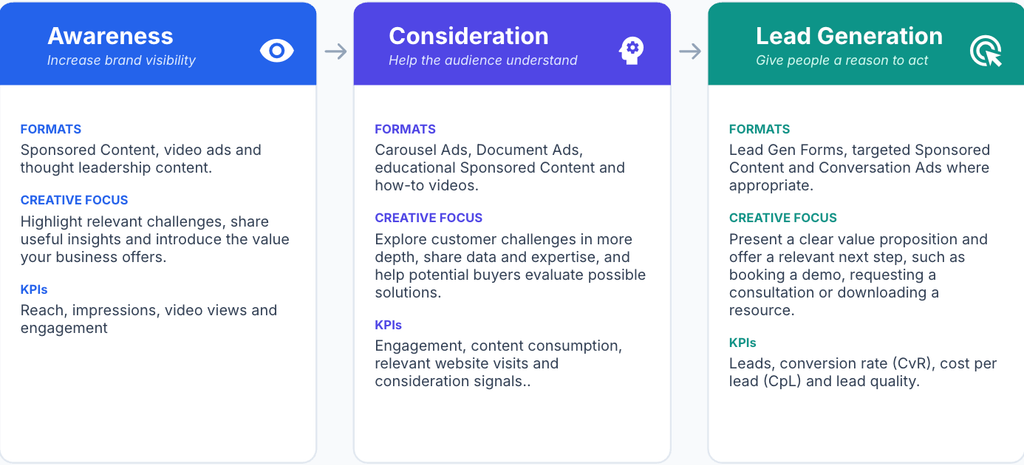
These stages should not be treated as a rigid or strictly linear journey. Formats can support different objectives depending on the audience, the offer and how the campaign is designed. A video, for instance, can introduce a problem to a new audience or help an existing prospect understand a solution in more depth.
The Takeaway: Plan what each campaign needs to achieve before deciding how to deliver it. A full-funnel strategy works best when objectives, messaging, formats and measurement support one another.
3) Make creativity part of the media plan
Targeting determines who sees your ads, but creativity helps determine whether they pay attention and understand why your solution matters. In B2B, it needs to do more than stand out in the feed: it should communicate value clearly, make complex topics easier to understand and give potential buyers a reason to consider your business over the alternatives.
At GA, we focus on three principles to guide creative testing:
- Stop the scroll: use a clear hook, an easy-to-read visual and a value proposition that audiences can understand within seconds.
- Make complex topics accessible: use carousels, data-led visuals and how-to videos to break down technical concepts into more digestible pieces of content.
- Test with a purpose: compare hooks, pain points, value propositions and formats against clear hypotheses, rather than changing multiple elements at once without knowing what you want to learn.
Creative testing is also becoming easier to scale. In July 2026, LinkedIn introduced new AI-powered creative tools, including AI Ad Variants, Flexible Ad Creation, Brand Kit and Draft with AI. These features are designed to help advertisers develop creative options, work more efficiently and explore different approaches to ad creation and personalisation.
LinkedIn reports that advertisers running five or more ad variants achieve, on average, a CTR more than 20% higher than those running just one. This suggests that creative variety can be valuable, but producing more variants does not guarantee better performance. The priority is to test meaningful differences and use the findings for future creative decisions.
Turn the plan into a cycle of learning
An annual strategy should set a clear direction while leaving room to adapt as new evidence emerges.
To turn your 2027 strategy into an actionable roadmap, start with three steps:
- Audit what worked: review performance by audience, format, message and campaign objective. Identify the strongest results, distinguish established patterns from early signals, and use these findings to inform budget allocation.
- Build a testing roadmap: plan progressive experiments across targeting and creatives. Define the question each test should answer, the variables you will change and the metrics you will use to evaluate the outcome.
- Use platform features where they add value: evaluate LinkedIn’s tools against your strategy’s needs. Could creative tools help you develop relevant variants more efficiently? Could audience options improve account selection? Would more advanced measurement help you understand whether your campaigns are contributing to business outcomes? Choose features based on their relevance to your objectives, not simply because they are new.
The result should be a plan that evolves with the evidence, helping your team make more informed decisions throughout the year.
Planning for 2027? Get in touch with our team to explore how a more data-led approach to LinkedIn Ads can help you turn campaign insights into smarter decisions.
Sources
The B2B Performance Principles: What Actually Drives Pipeline on LinkedIn, LinkedIn, 7 October 2026.
From Blank Page to High Performing Ad: Introducing LinkedIn’s New Creative Tools, LinkedIn, 1 July 2026.

Article author

Ilenia Testa
Account Executive