
















Top Points
ChatGPT 5 is here and it is already stirring debate in the marketing world. Here’s what matters most:
- Smarter and faster – improved accuracy, larger context handling, and multimodal input.
- Practical uses – content creation, keyword strategy, personalisation, semantic search, and insights.
- Risks remain – outputs can be inconsistent or off-brand without oversight.
- Human guidance is key – strategy and judgement still drive results.
- Best approach – experiment in controlled ways before scaling.
Understanding ChatGPT 5
OpenAI has released ChatGPT 5 and the conversation around its impact is already moving quickly. Some see it as a breakthrough for content and search strategy while others are asking harder questions about how it will fit into established workflows.
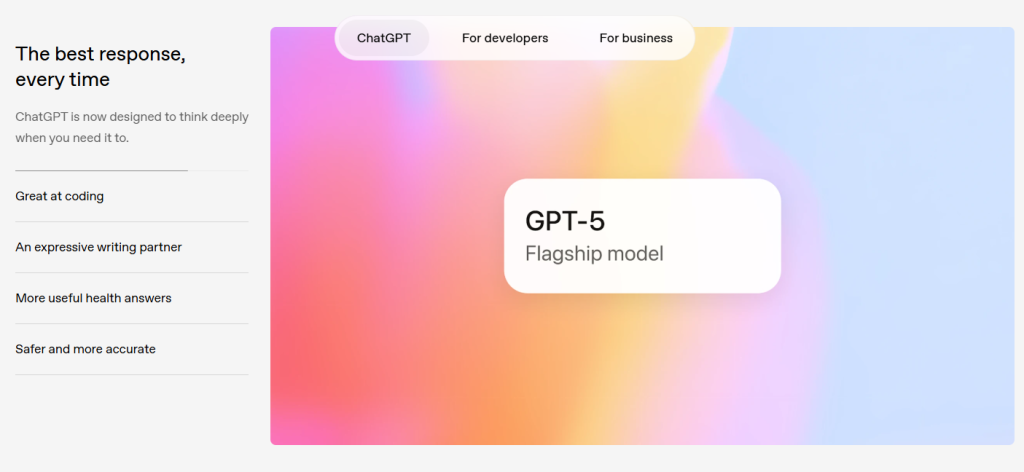
So what exactly is new here? Compared to earlier versions, GPT 5 handles larger amounts of information, produces more accurate and context-aware responses, and supports multiple input types, primarily text and images. It is faster, more consistent, and better at managing longer conversations. These improvements have obvious implications for content, search, and customer engagement, but they also raise new questions about how brands should adapt.
At GA Agency we believe the most useful way to approach GPT 5 is with curiosity rather than hype. The model introduces capabilities that are impressive, but the real test is how businesses decide to integrate them into strategy without losing the human judgment that drives campaigns forward. Technology alone is not enough. The advantage comes when expert marketers know how to guide and apply it.
Areas Where GPT 5 Could Influence Marketing
Here are the aspects that stand out most clearly right now:
Content That Works Harder
GPT 5 can produce large volumes of written material across different formats from blog posts to ad copy. For brands this opens the possibility of scaling content calendars more quickly. Yet more output is not always better. Marketers still need to decide what is worth publishing, how it fits a wider content architecture and how it reflects the brand’s tone.
Keyword Strategy That Goes Beyond Lists
One of GPT 5’s strengths is processing patterns in data which could make it useful for identifying not only high volume keywords but also long tail and intent based queries. If used well this may give marketers a sharper view of how people are searching. However, as always, the value comes from interpreting those results correctly and turning them into a tailored strategy rather than chasing every keyword it suggests.
Personalisation That Feels Human
GPT 5 can adapt site content, chat experiences and email campaigns to each visitor with impressive accuracy. Yet personalisation is not only about automation. Marketers still need to define the tone, the timing and the value exchange that turns personalisation into real engagement.
Built for Semantic Search and Modern SERPs
Search engines increasingly reward context and meaning rather than keyword density. GPT 5’s natural language capabilities can help brands create content aligned with semantic search trends. While this improves content quality and relevance, stronger rankings still depend on how well marketers apply expertise and strategy.
Real Time Insights & Trend Analysis
GPT 5 can quickly analyse competitor moves, audience shifts and industry signals when connected to live data sources. This gives marketing teams sharper inputs for fast decision making. Yet it still takes human judgment to know which signals matter and how to act on them effectively, without chasing noise.
The Limitations of GPT 5
While the potential is clear, GPT 5 is not without risks. Outputs can still be inaccurate, generic, or inconsistent with brand guidelines if left unchecked. There are also wider considerations around data security, compliance, and ethical use. For businesses, this means adopting GPT 5 should never be a plug-and-play approach. Human oversight is critical to ensure quality, credibility, and alignment with long-term objectives.
How Businesses Can Start Experimenting
The best way to explore GPT 5 is through structured, low-risk experimentation. That might include:
- Piloting its use in content ideation rather than publishing directly.
- Testing ad copy variations in controlled campaigns.
- Exploring chat experiences on non-critical parts of the site.
- Using it as a research assistant for trend monitoring, with human review before action.
This phased approach allows businesses to test potential while keeping safeguards in place.
Why This Matters
The release of GPT 5 signals that AI tools will continue to play a larger role in marketing but it does not replace strategy. For businesses the right question is not whether to adopt AI immediately but how to evaluate where it adds value and where human direction remains essential.
Agencies and in-house teams that approach GPT 5 with a balanced perspective will be best positioned to test its potential while keeping strategy grounded in business objectives.
Closing Thought
ChatGPT 5 is not a solution on its own. It is a tool that may open new possibilities for content creation, search optimisation and customer engagement. Whether it becomes a long term advantage will depend on how thoughtfully it is applied.
For now the opportunity is to stay curious, experiment responsibly and make sure that human expertise continues to set the direction.
At GA Agency we help brands explore new technologies without losing sight of the bigger picture. If you want to understand how tools like GPT 5 can be tested and applied responsibly to strengthen your digital marketing strategy, get in touch with our team today!

Article author

Chiara Riva
Business Development Assistant