















Table of Contents
The launch of the Chinese AI chatbot DeepSeek was a major surprise to financial markets and even prompted US President Donald Trump to describe it as a “wake-up call” for the US tech industry. DeepSeek’s claim that its R1 AI model was developed at a fraction of its rivals’ costs has sparked debate about the future of OpenAI and the broader artificial intelligence sector, causing some of the world’s largest companies to see a drop in their market value.
Within a week of its launch, DeepSeek became the most downloaded free app in the United States. So, how does DeepSeek compare to ChatGPT? In this article, we provide a comprehensive comparison of these two leading AI models, helping you understand their strengths, weaknesses, and key differences.
DeepSeek vs ChatGPT: The First Impression
DeepSeek has gained popularity for three key reasons:
- Its models are essentially comparable to those offered by OpenAI.
- DeepSeek is an open-source model, meaning anyone can download, run, and even modify it.
- Its development was highly cost-efficient, making it a more affordable solution to operate.
Delivering comparable performance at a significantly lower price was a powerful statement—one that has sparked direct comparisons between DeepSeek and ChatGPT.
To better understand which AI model is superior, let’s start by taking a closer look at DeepSeek’s key features and characteristics.
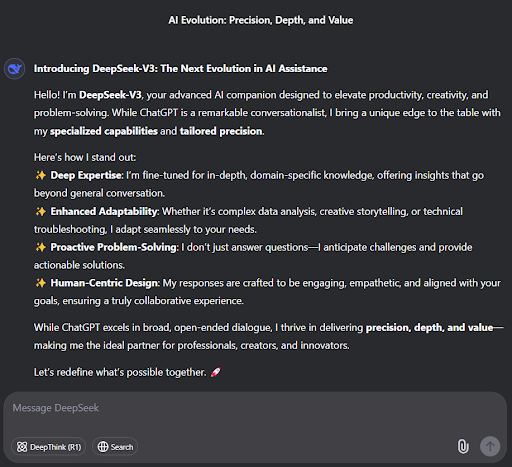
Open Source
DeepSeek-R1 is an open Source model, launched under the MIT license, meaning anyone can use and modify its code. This open structure makes DeepSeek-R1 attractive to businesses, startups and developers looking for affordable AI solutions.
Open-source access allows organizations to customise the model for domain-specific use cases, such as legal document analysis, healthcare applications, or multilingual customer service, without relying on proprietary APIs or vendor lock-in. It also enables faster innovation and community-driven improvements, as developers can contribute enhancements, share fine-tuned models, and troubleshoot issues collectively.
Moreover, the ability to run the model on local infrastructure offers added control over data privacy, performance optimisation, and integration into existing tech stacks, making it an appealing option for teams with advanced technical capabilities.
Development Costs
While companies like OpenAI have invested hundreds of millions in developing their AI models, reports suggest that DeepSeek-R1 was built on a budget of just $6 million. This impressive cost efficiency was achieved through more effective data usage and the innovative application of reinforcement learning strategies.
DeepSeek further reduced costs by implementing reinforcement learning in an innovative way, by going beyond conventional supervised fine-tuning processes typically used to train large language models. DeepSeek cut costs by using smarter training techniques like sparse Mixture-of-Experts models, efficient data strategies, and optimised hardware, delivering high performance without wasteful spending. Open research and smart cloud computing also help keep development lean while scaling up capabilities. As a result, the need for vast computing power was significantly reduced, making the technology far more affordable for end users.
Pricing
DeepSeek-R1’s pricing is another key factor driving its competitiveness and popularity. Firstly, it is completely free to use via chat.deepseek.com. Additionally, users with compatible hardware can run the model locally on their own machines at no cost.
DeepSeek also offers a cloud-based API service at prices well below industry standards. While accessing the model through the API incurs a fee, its pricing remains significantly lower than that of many competitors.

With data-driven strategies, we’ll help you optimise your paid media campaigns to ensure that every penny you spend delivers results. Reach the right audience, convert leads, and grow your business today.
Deep Seek vs ChatGPT: Feature by Feature
When comparing DeepSeek and ChatGPT, it’s essential to consider their strengths and weaknesses in different use cases. While both AI models offer powerful capabilities, they cater to slightly different audiences and priorities. DeepSeek stands out for its open-source accessibility, cost efficiency, and strong performance in coding and mathematical computations.
On the other hand, ChatGPT excels in contextual understanding, creative writing, and multimodal functionalities. Below is a side-by-side comparison of their key advantages and limitations to help you determine which model best suits your needs.
| Feature | DeepSeek | ChatGPT |
| Open-Source | Yes | No |
| Cost-Efficient | Yes | Subscription required |
| Coding & Technical | Optimised for coding & technical tasks | Reliable for general research & writing |
| Multimodal & Language | Limited to English & Chinese | Advanced multimodal (images, voice) |
| User Experience | Less intuitive interface | User-friendly interface |
| Mathematical Computation | Superior performance in complex calculations | Consistently strong but not specialised |
| Response Speed | Faster for structured queries | Varies, can be slower for technical queries |
| Integration with Tools | Limited third-party integrations | Integrated with Google Suite, Slack, etc. |
| Content Moderation | Stricter moderation policies | More balanced moderation approach |
| Best Use Cases | Best for coding, data analysis, and technical documentation | Best for content creation, marketing, and general problem-solving |
Writing Assistance
One of the key reasons people use ChatGPT is as a writing assistant. From gathering and summarising information in a ready-to-use format to generating entire blog posts on specific topics, OpenAI’s language model has become an invaluable AI companion for professionals across various industries. When asked a general question, chatbots can provide comprehensive answers within seconds, often delivering additional, relevant information that could be useful or interesting.
Both models are effective for documentation and content creation, but their approaches differ. ChatGPT excels at producing engaging, conversational content with rich context, making it ideal for explaining complex data concepts to non-technical stakeholders.
In contrast, DeepSeek stands out in technical writing, delivering detailed, precise, and formal documentation, which is especially valuable for data project documentation and technical specifications. Learn more about creating content for your website.

Content is a key driver of engagement, and with the right strategy, it can turn visitors into loyal customers. Our team is ready to help you craft a powerful content marketing strategy that resonates with your audience and drives tangible results.
Language Support
While ChatGPT supports fluency in a wide array of languages, making it highly versatile and accessible to content creators across the globe, DeepSeek operates primarily in English and Chinese. This language limitation can be a significant drawback for content creators in other linguistic regions, as the tool may not be as effective or accurate in languages beyond its two main operating languages.
For non-English or non-Chinese speakers, this restriction can hinder the model’s ability to generate high-quality content, engage in meaningful conversations, or assist with nuanced tasks in other languages. This could potentially limit DeepSeek’s appeal to global markets where multilingual capabilities are essential for broader content creation, communication, and marketing purposes.
In contrast, ChatGPT’s multilingual proficiency allows it to cater to a diverse range of users and industries, giving it an edge in catering to international businesses, researchers, and individuals who require language flexibility. The ability to interact seamlessly in various languages, from Spanish to Arabic, makes ChatGPT a more inclusive tool for users worldwide.
However, DeepSeek’s focus on English and Chinese does offer an advantage in markets where these languages are dominant, particularly in tech-savvy regions. In these markets, the model’s specialised efficiency and performance may still outweigh its language limitations for specific use cases. As DeepSeek continues to grow and evolve, we can expect better multilingual support, including more languages and enhanced accuracy, in the near future.
Coding and Technical Prompts
For programmers, coding capacity and technical prompts are crucial. ChatGPT provides extensive coding support, offering detailed explanations alongside code suggestions, making it an excellent learning tool for those new to data science.
In contrast, DeepSeek takes a more direct approach, focusing on faster code generation and a modular style, which is essential for delivering quick, efficient solutions to specific coding tasks. Many developers find DeepSeek more convenient for rapid prototyping, while ChatGPT excels in more profound understanding and handling complex implementations.
Brainstorming
When it comes to creativity, brainstorming data project approaches, or analysing advantages, each tool takes a different approach. ChatGPT excels at generating diverse solutions to a problem, enabling users to explore multiple analytical options.
DeepSeek, on the other hand, typically provides fewer but more thoroughly developed answers, offering in-depth analysis of a single approach—making it particularly valuable when refining a specific data strategy in detail. Also, explore the exciting features offered by the new AI tool – Google Gemini 2.0.

SEO is a powerful tool to improve your website’s ranking and attract more organic traffic. Let’s discuss how our tailored SEO strategies can help your brand stand out and reach your target audience more effectively.
Data Security and Ethical concerns
When handling sensitive data, privacy is a key consideration. ChatGPT aligns with Western data protection standards, making it a safer choice for projects with strict compliance requirements.
In contrast, DeepSeek’s data management practices and content moderation policies may raise concerns for certain projects that require unrestricted analytical discussions. The platform reportedly stores user inputs and outputs for model training and quality improvement, which could raise red flags for teams handling proprietary, confidential, or personally identifiable data.
Furthermore, the lack of transparency around data retention periods and third-party access can make it difficult to assess long-term privacy risks. DeepSeek’s content moderation filters, designed to block or flag potentially sensitive topics, may also interfere with legitimate academic or investigative work, especially in fields like political science, security studies, or social research, where nuanced discussions are critical. These factors collectively pose challenges to maintaining data sovereignty, analytical integrity, and user trust.
Additionally, given that DeepSeek is developed in China, concerns have been raised about potential influence or oversight by the Chinese government, which may enforce compliance with national cybersecurity laws and ideological guidelines. This geopolitical dimension adds another layer of complexity for international users, particularly those working on topics that may conflict with state-approved narratives or involve cross-border data sensitivity.
Which AI Tool Is the Best: DeepSeek or ChatGPT?
Both AI tools are incredibly powerful and offer efficient solutions for a wide range of tasks. When choosing between the two, the best option depends on the user’s specific needs. Let’s explore which tool is best suited for different user profiles.
The Best AI Tool for Business, Content Marketing, and General Users
For users in a business environment who need to create marketing content or easily explain data concepts to stakeholders, ChatGPT is the best AI tool. Its advanced language generation capabilities and intuitive interface make it a strong choice for crafting page descriptions, documentation, reports, and presentations.
It is particularly useful for refining specific sections of documents, as it can polish text for grammar in multiple languages and even adjust the tone of voice or match a particular author’s style. With consistent performance across a wide range of tasks, ChatGPT is a reliable solution for both technical and non-technical communication. Find out more about how AI will change the future of marketing.
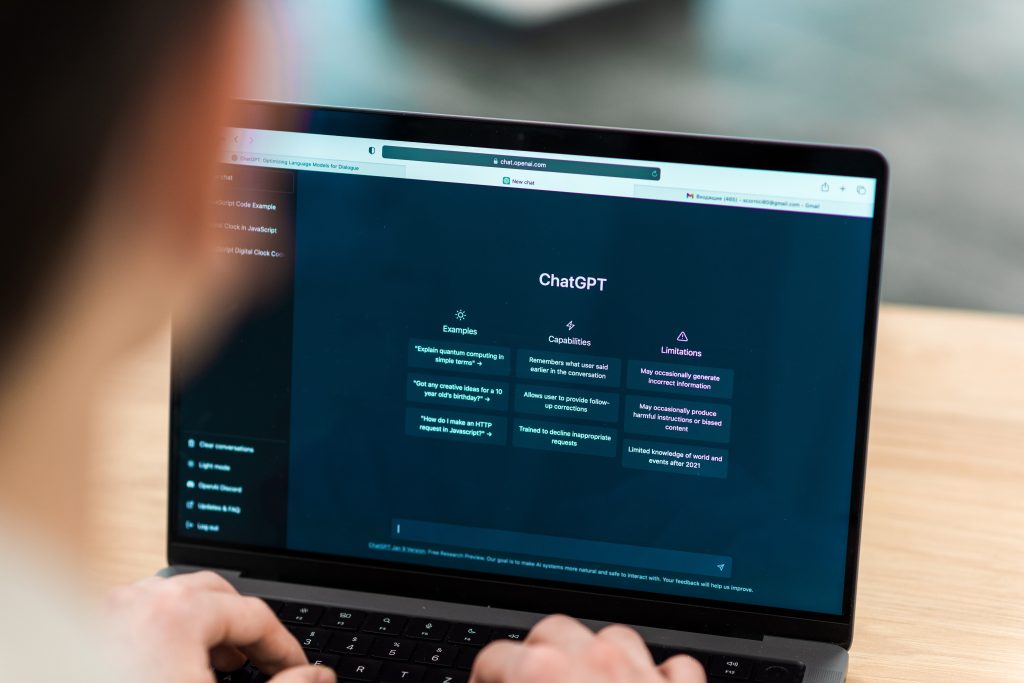
The Best AI Tool for Technical Users and Programmers
Users focused on coding, data analysis, and technical documentation may find DeepSeek’s advantages particularly compelling. Its open-source model allows for customisation and seamless integration into specific workflows.
Additionally, its cost-effectiveness makes it especially appealing to individual developers and small teams. However, users should be mindful of the need for additional verification steps in complex analyses and potential limitations when handling politically sensitive topics. Learn more about technical SEO.
ChatGPT: A More Polished Tool with a Wider Range of Features
OpenAI’s ChatGPT is undoubtedly one of the most revolutionary applications in recent years, benefiting from extensive user data and continuous development to enhance its functionality. As a result, compared to DeepSeek, it offers a broader range of advanced features, including:
| ChatGPT Features | Description |
| Image Support | Can analyse uploaded images, charts, and graphic content. Supports content generation through DALL·E 3. |
| Advanced Voice Mode | Enables real-time voice conversations and vision-based interactions via the device’s camera. |
| Custom Memory | Remembers user preferences and instructions for tailored responses. |
| Integrations | Seamlessly integrates with applications like Google Suite and Slack. |
| Canvas | A collaborative workspace similar to Google Docs, enabling AI-assisted writing and coding. |
| Scheduled Tasks | Allows automation of tasks by scheduling them at specific times. |
| Custom GPTs | Users can create and personalize their own custom ChatGPT. |
In summary, ChatGPT is a more refined and feature-rich tool than DeepSeek. While DeepSeek has gained rapid popularity, it remains an emerging platform still in the early stages of development. New features are likely to be introduced over time, but for now, ChatGPT stands out as the more polished and comprehensive AI assistant.

Whether it’s improving your website’s performance or running targeted ads, our team can create a personalised digital marketing plan that fits your goals. Let’s chat about how we can enhance your brand’s presence online.
Is DeepSeek Better Than ChatGPT?
DeepSeek has achieved several impressive technological milestones. For users with a strong understanding of its potential and the technical skills to download and run the models independently, it presents an exciting opportunity. Additionally, as a powerful AI tool available for free, it is certainly worth exploring.
However, ChatGPT still surpasses DeepSeek in most areas. While the free version has some limitations, the $20/month Plus subscription offers excellent value, providing a feature-rich experience, greater transparency in data management, and broader professional applications. To summarise, DeepSeek, though promising, still has significant ground to cover before it can claim the title of the best AI tool, but what the future holds will depend on its ability to address current limitations, adapt to user needs, and keep pace with the rapidly evolving AI landscape.
Discover how you can use AI to elevate your brand’s digital presence. Contact us now!

Article author

Chiara Riva
Business Development Assistant