














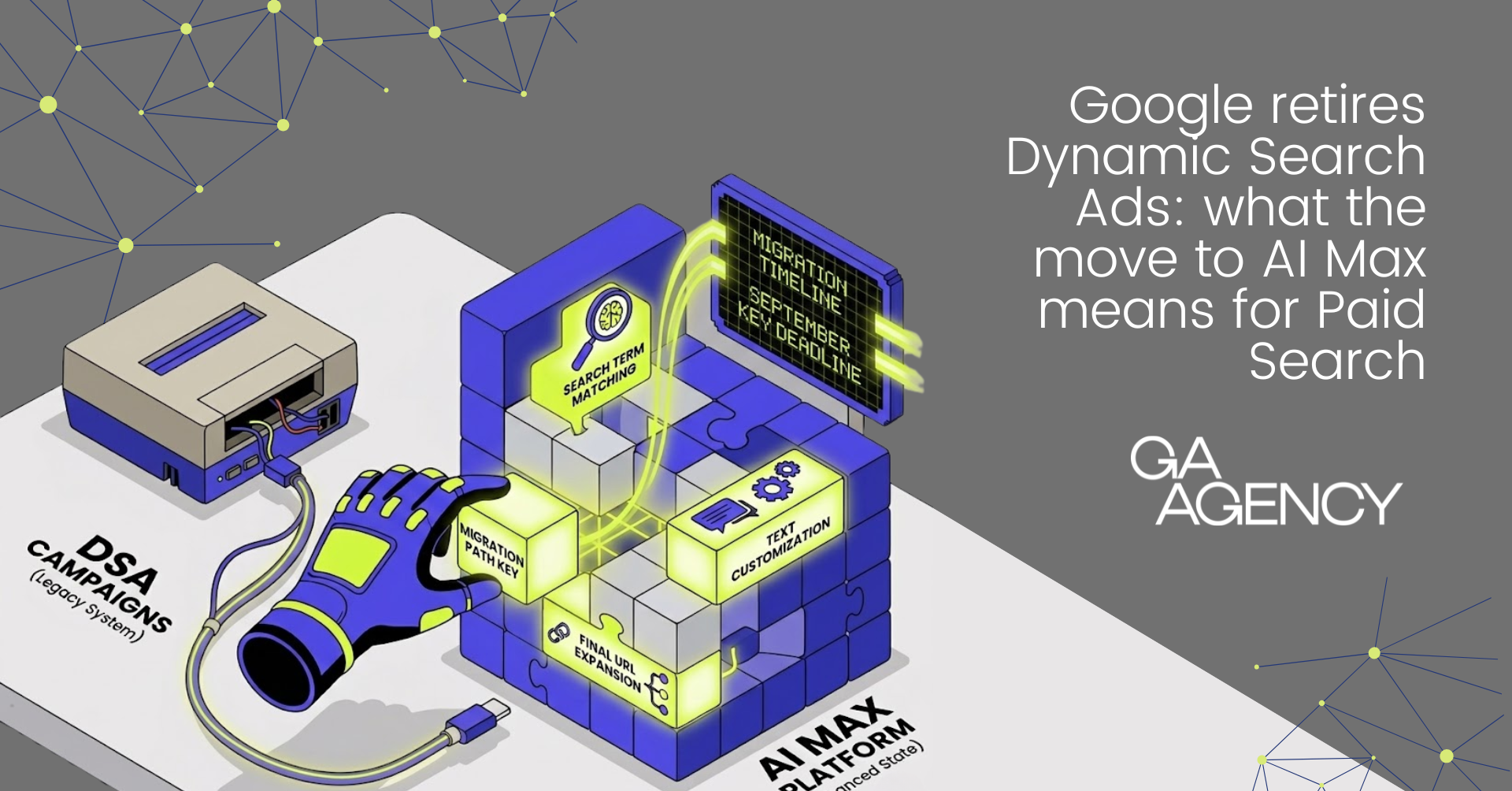
On 15 April 2026, Google announced that Dynamic Search Ads (DSA) will be retired as a standalone format. Starting this September, all eligible campaigns will be automatically migrated to Google’s new generative AI framework: AI Max for Search. It is not merely a technical update but also a shift in how search budgets should be deployed and how brand messaging is generated.
Following is a breakdown of what AI Max actually does differently, what is changing and what paid search teams should be doing between now and September.
What Google has announced
The retirement affects three legacy campaign configurations: Dynamic Search Ads, automatically created assets (ACA) and campaign-level broad match settings. From September, advertisers will no longer be able to create new DSA campaigns. Existing campaigns will be automatically upgraded, with all eligible migrations expected to complete by the end of Q3.
The transition runs in two phases. Voluntary upgrade tools are rolling out now, giving advertisers the opportunity to migrate on their own terms before the forced switch begins.
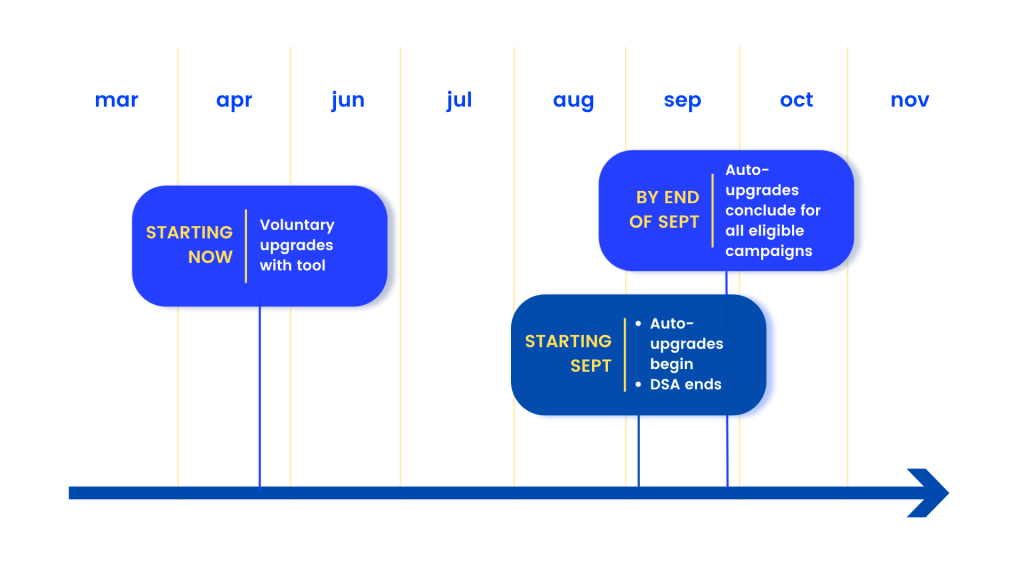
For those who do not act, the automatic migration applies the following defaults by campaign type:
- DSA campaigns will convert to standard ad groups with all three AI Max features (search term matching, text customisation, final URL expansion) enabled by default.
- ACA campaigns will move to AI Max with search term matching and text customisation turned on by default.
- Campaign-level broad match campaigns will migrate with search term matching enabled by default.
Whilst the auto switch can be the least manual of the available options, it’s worth noting that allowing Google to auto-migrate your campaigns means adopting default settings engineered for maximum reach, which could lead to initial budget inefficiencies & fluctuations in performance.
How AI Max differs From DSA
DSA has long functioned as a useful growth mechanism, using website content to generate headlines and match queries beyond an advertiser’s keyword list. AI Max is designed to go further: as a predictive, generative engine, rather than relying solely on static landing pages, it processes real-time contextual signals to determine user intent and then dynamically invents ad copy to match.
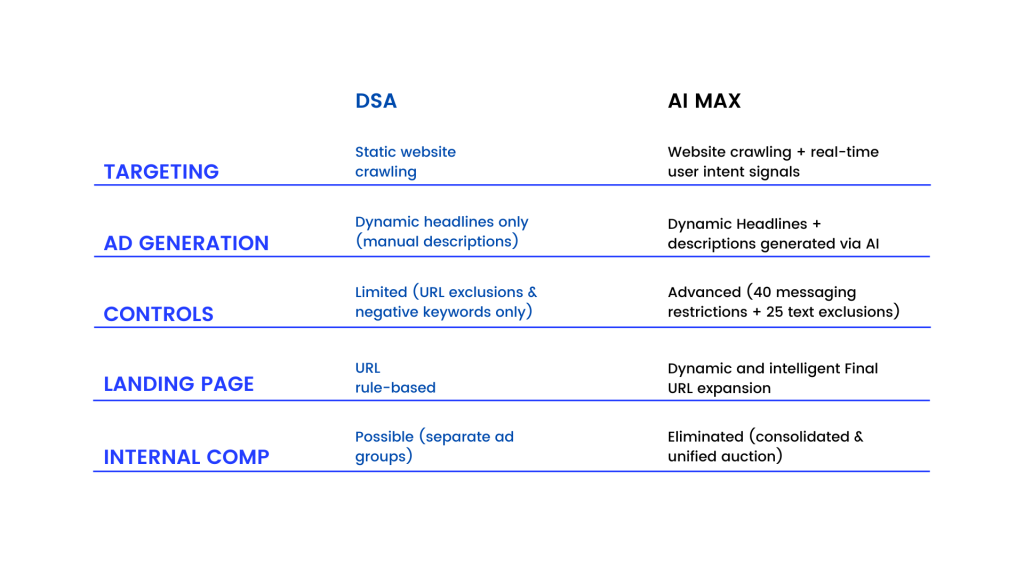
The three core features work as follows:
1. Search term matching
AI Max expands reach by identifying additional relevant queries based on a combination of advertiser inputs and real-time intent signals, replacing the deterministic webpage-only logic of DSA.
2. Text customisation
Ad copy is now generated dynamically based on website content and existing ads. Advertisers can apply text guidelines to influence what the AI produces, specifying up to 25 term exclusions and 40 messaging restrictions. This is a meaningful governance tool that requires careful configuration to ensure brand compliance.
3. Final URL Expansion
AI Max dynamically selects the most relevant landing page for a query. Crucially, it brings dynamic and standard keyword ad groups into a unified structure. This removes internal competition, ensuring your campaigns no longer bid against themselves in the auction.
Interpreting Google’s performance claim
Google reports that advertisers using the full AI Max feature set see an average 7% lift in conversions or conversion value at a similar CPA/ROAS compared with search term matching alone. Two caveats are worth keeping in mind.
- This 7% lift is compared against search term matching in isolation, not against fully optimised DSA directly.
- The figure applies exclusively to non-retail advertisers and no sample size is disclosed. Early independent benchmarks indicate that post-migration performance is highly volatile depending on account structure, conversion signal quality and how tightly exclusions and controls are configured.
What Paid Search Teams Should Do Now
Migrate voluntarily before September
Google strongly recommends making the transition to AI Max ahead of the auto-migration for full oversight and control. By transitioning on your own timeline, you can carefully establish a clear testing roadmap and baseline to train the algorithm, without suffering the sudden Q4 volatility that accompanies forced default settings.
Audit exclusions and controls before migrating
The text guidelines and brand controls in AI Max are more granular than DSA, but they are only effective if utilised correctly. Reviewing existing DSA exclusion lists and mapping them to AI Max controls before migration is more reliable than applying them afterwards.
Establish a pre-migration performance baseline
Because AI Max limits granular visibility into search term reporting, proving ROI post-migration will be challenging. Exporting conversion data, search term reports and landing page metrics for active DSA campaigns provides a reliable baseline to assess whether the new AI is outperforming the old system.
Do not treat keywords as redundant
Google confirms that keywords remain central to campaign strategy: they provide the intent signals that the AI uses as inputs. AI Max extends beyond keyword lists but it does not replace them. Accounts that reduce keyword structure in anticipation of the migration risk degrading the data the AI trains on.
Looking Ahead
The retirement of DSA is consistent with the broader direction Google has pursued across its advertising platform: consolidating legacy formats that require more manual input in favour of AI-led automation. This mirrors the earlier transition from Smart Shopping to Performance Max and underscores the reality that page-based targeting is no longer sufficient for complex search behaviours.
With the September deadline set, the most practical move for paid search teams is to guide the migration manually now. By migrating voluntarily, you can shape the transition on your own terms rather than relying on Google’s automated rollout in the fall.
Navigating the AI Max transition requires a deliberate strategy – if you want to discuss your Paid Media advertising strategy & future-proofing your accounts, get in touch with our expert team today!
Sources
- https://blog.google/products/ads-commerce/dsa-upgrade-to-ai-max-2026/
- https://searchengineland.com/google-retire-dynamic-search-ads-ai-max-474262
- https://www.seroundtable.com/google-ads-dsa-ai-max-41170.html

Article author

Chiara Riva
Business Development Assistant