
















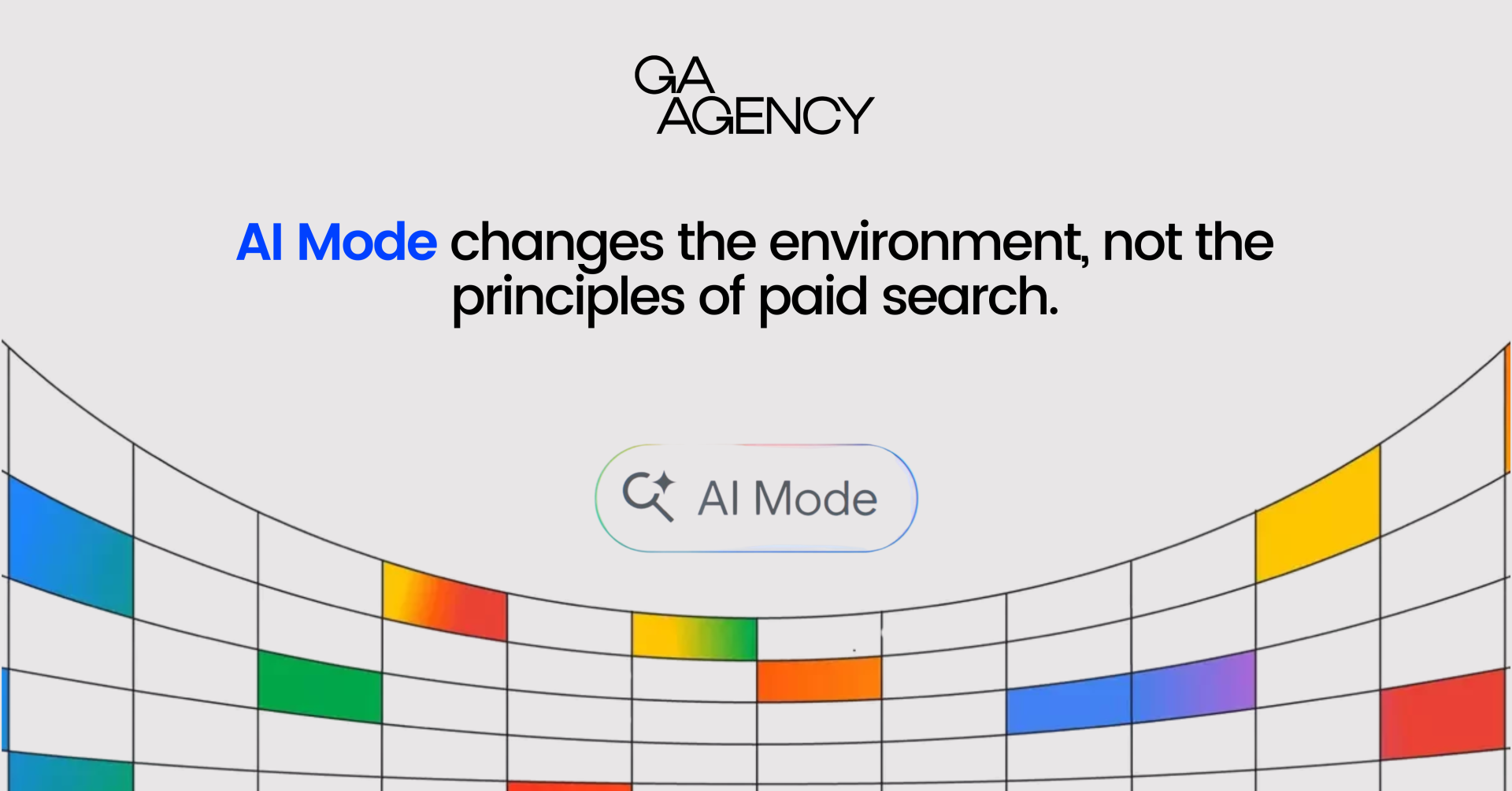
Google announced four new Gemini-powered ad formats at Google Marketing Live in May 2026. Most of the coverage treated them as a rupture, a new era requiring an entirely different approach to paid search. That framing is understandable, but also misleading.
The more accurate read is simpler. Advertisers using Performance Max or AI Max for Search automatically qualify for AI Mode placements – no separate campaign creation is needed. But asset quality and feed accuracy determine visibility. The underlying machine has changed; the inputs that feed it have not.
What Google actually announced
The announcements cover two formats currently in testing within AI Mode (Conversational Discovery ads and Highlighted Answers) and two formats coming to standard Search in the months ahead: AI-powered Shopping ads and Business Agent for Leads.
According to Google, AI Mode has surpassed 1 billion monthly users, with queries more than doubling every quarter since launch. That growth is the commercial logic behind building ad formats native to the surface rather than adapting existing ones.
Conversational Discovery ads work by reading the full intent of a user’s query and generating ad creative in real time. The Gemini model builds creatives tailored to that search, highlighting specific relevant features. The example Google used – someone asking for low-maintenance ways to make their home smell like “fancy spas or a rainy forest” – illustrates the format’s logic: the query is rich, exploratory and specific and the ad responds to those characteristics.
Each ad runs alongside an independent AI explainer that Gemini writes from product or service information separate from the advertiser’s own creative. Both elements are clearly labelled Sponsored.
Highlighted Answers work differently. When AI Mode generates a list of recommendations in response to a research query, advertisers with highly relevant, high-quality ads are eligible to appear as one of the items on that list. The eligibility condition is dual: the ad must be highly relevant and high quality.
The two formats coming to standard Search (AI-powered Shopping ads – which generate real-time explainers for high-consideration purchases – and Business Agent for Leads) follow the same structural logic. For brands, AI-powered Shopping ads should be the priority, launching first as a US-only rollout later in 2026. This phased release gives international and EMEA-based brands a critical window to get their data infrastructure in order before the formats go global.
Why the fundamentals still govern visibility
The narrative that AI Mode requires an entirely new paid search approach is tempting, but it gets the causality backwards. These formats are expected to reward rigour, not novelty. Four areas where this is clearest:
1. Ad copy clarity is now doing more work, not less
In a standard Search auction, a well-crafted headline influences CTR. In AI Mode, queries are, on average, three times longer than traditional searches. Your ad copy now becomes source material for Gemini’s creative generation. Gemini assembles ads from the assets you provide. Give it range: multiple images, varied headlines, different value-proposition angles and product feature descriptions written for conversational context. Clarity about what a product does and who it is for is the brief that Gemini works from.
2. Feed quality determines Shopping eligibility
For AI-powered Shopping ads, sparse or inconsistent feeds produce weak creative. Audit your Google Merchant Center feed for attribute completeness, accurate inventory and descriptive product attributes. This is not a new recommendation: feed hygiene has been a visibility lever in standard Shopping campaigns for years. AI Mode’s real-time explainer generation makes incomplete feeds more consequential, not less. Google’s Shopping Graph contains more than 60 billion listings; brands with well-structured, complete product data are the ones best positioned to stand out.
3. Audience signals and first-party data govern intent matching
Google’s AI determines when an ad is relevant enough to show based on the conversational context and perceived user intent. Broad Match paired with smart bidding feeds the system more intent signals; thin audience data or a single conversion goal constrains it. The advertisers best placed for AI Mode are those who have already done the work on first-party data, enhanced conversions and conversion event diversification.
4. Landing page relevance has become the rate-limiting factor
Conversational searches arrive with specific and refined intent, so generic landing pages convert poorly. Match landing page content to the kind of exploratory, problem-solving queries these formats target. A user arriving from a Conversational Discovery ad has expressed a nuanced, context-rich intent. A landing page built around a broad category term will not meet them where they are.
What to do about it
- Review your asset library against the new creative logic. Audit current RSA and Performance Max assets for specificity. Generic headlines produce weaker Gemini output than ones that communicate a distinct value proposition.
- Audit your product feeds before the formats roll out. AI-powered Shopping ads make Merchant Center feed completeness a priority task. Title quality, attribute depth and inventory accuracy feed the real-time explainer model.
- Expand your conversion event coverage. Smart bidding in AI Mode depends on quality signals. If your current setup optimises for a single macro-conversion, add micro-events to give the model more to work with.
- Check your campaign eligibility. To run the new formats, campaigns need to sit on AI Max for Search, AI Max for Shopping or Performance Max. Standard Search campaigns do not currently qualify.
The broader point
These announcements show how paid search expertise is fundamental in this fast-paced environment. When Google’s AI generates your creative, the quality of what it generates is bounded by the quality of what you have given it: your assets, your feed, your signals, your landing pages. Human oversight is the strategic layer above automation.
The brands that will perform in AI Mode are those whose paid search fundamentals are already sound. If you want to understand where your brand stands against these new benchmarks, get in touch with us.

Article author

Chiara Riva
Business Development Assistant