
















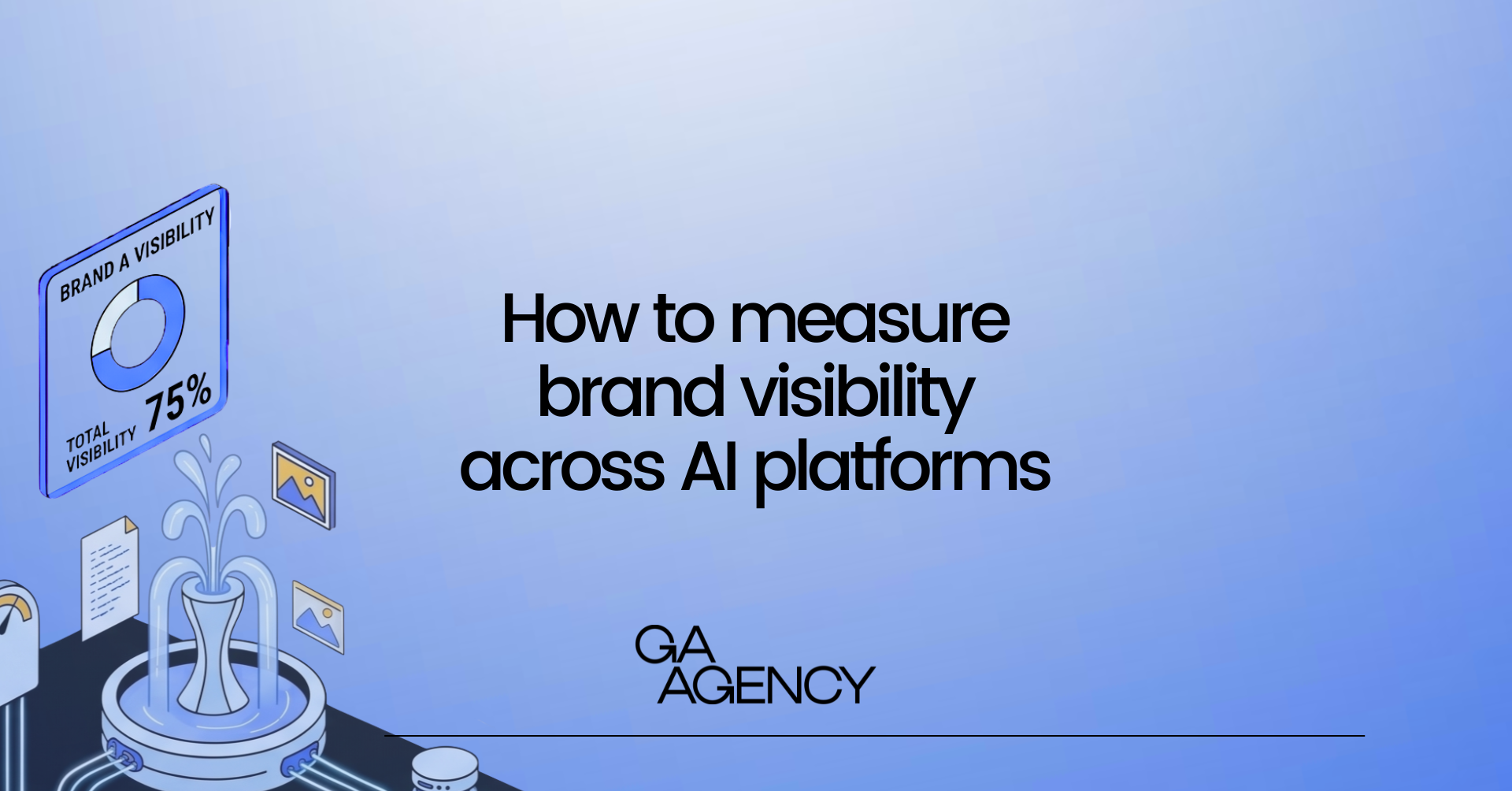
Traditional SEO metrics like rankings and click-through rates tell only part of the story in 2026. As AI-driven search platforms handle increasing query volume, brands need new measurement frameworks to understand where they appear, how they’re portrayed, and whether their visibility strategies are working.
Unlike traditional search where performance is measured through position in results pages, AI platforms synthesize information from multiple sources and present it conversationally. Your brand might be mentioned without being linked, cited as a source without driving traffic, or recommended alongside competitors in ways that don’t map to traditional ranking metrics.
This article explains what to measure when tracking brand visibility across AI platforms, which metrics matter most, and how to build a measurement framework that captures AI-driven search performance.
What Are LLMs and AI Search Platforms?
LLM stands for Large Language Model—the AI technology powering conversational search platforms like ChatGPT, Google’s Gemini, Claude, and Perplexity. These models are trained on vast amounts of text data and can understand, generate, and reason with natural language.
When integrated into search platforms, LLMs enable conversational interactions where users ask questions naturally and receive synthesized answers rather than lists of links. These systems use techniques like query fan-out to break complex queries into multiple sub-questions, retrieve information for each, and synthesize comprehensive responses.
Key AI search platforms in 2026:
- ChatGPT (OpenAI) – Conversational AI with optional web search, used by millions for research and discovery
- Google AI Mode – Google’s conversational search combining LLM capabilities with Google’s search index
- Perplexity – AI search engine providing synthesized answers with cited sources
- Claude (Anthropic) – Advanced LLM used for research and analysis
- Microsoft Copilot – Integrated into Bing and Microsoft products
Unlike traditional search engines that retrieve and rank web pages, these platforms retrieve information from multiple sources, synthesize it, and present coherent answers. This fundamental difference is why traditional SEO metrics don’t fully capture visibility in AI-driven search.
Why AI Platform Tracking Matters
AI-driven search is no longer experimental. ChatGPT, Google AI Mode, and Perplexity handle billions of queries monthly, and adoption continues to accelerate. For many categories, particularly B2B software, professional services, and technical products, significant research and evaluation now happens within AI interfaces rather than traditional search results.
This creates visibility challenges traditional SEO metrics don’t capture. A brand might rank first in Google’s traditional results but never appear in AI-generated responses. Conversely, a site with modest traditional search visibility might be cited frequently in AI responses due to content structure or topical authority.
Without tracking AI platform performance, brands operate blind to an increasingly important discovery channel.
Key AI Visibility Metrics To Track
Measuring AI platform performance requires tracking six interconnected metrics that reveal how your brand appears, how often, in what context, and relative to competitors.
| Metric | What It Measures | Why It Matters |
| Mentions | How often your brand appears in AI responses | Indicates awareness and topical relevance |
| Citations | Linked references to your content | Drives traffic and establishes authority |
| Share of Voice | Your visibility vs. competitors | Reveals competitive positioning |
| Sentiment | How your brand is portrayed | Shapes perception and consideration |
| Topic Coverage | Which queries trigger mentions | Identifies visibility gaps |
| Response Position | Where you appear in multi-brand responses | Influences consideration preference |
1. Mentions
Mentions are instances where your brand, product, or service is referenced in an AI-generated response, whether linked or unlinked. This is the foundational visibility metric.
Track mentions by:
- Query category (product comparisons, how-to guides, recommendations)
- Platform (ChatGPT, Google AI Mode, Perplexity)
- Context (positive, neutral, negative)
Volume alone doesn’t tell the full story, context and positioning matter significantly. Tools like BuzzWatch automate this tracking across platforms, categorizing mentions by sentiment and context to reveal the complete picture.
2. Citations
Citations are linked references where the AI system attributes specific information to your content and provides a clickable source. Citations drive referral traffic and establish authority.
Track:
- Citation frequency
- Which pages are cited most often
- Which query types generate citations
- Whether citations appear alongside competitors or as sole sources
3. Share of Voice
Share of voice measures how often your brand is mentioned relative to competitors for a defined set of queries. This reveals competitive positioning within AI-generated responses. At GA Agency, we use BuzzWatch to monitor share of voice across 50+ countries and multiple platforms, comparing your brand against up to 10 competitors simultaneously to identify competitive advantages and vulnerabilities.
Track share of voice by:
- Category
- Query intent (informational, comparison, purchase-focused)
- Platform
4. Sentiment
How your brand is described matters as much as whether it’s mentioned. AI responses can position brands positively (recommended, praised), neutrally (mentioned factually), or negatively (criticized, compared unfavorably).
Track sentiment by analyzing the language used when your brand appears. Are you described as “leading” or “expensive”? This reveals gaps between desired positioning and actual portrayal.
5. Topic Coverage
Topic coverage measures which subjects and questions generate mentions of your brand. This reveals where visibility is strong and where gaps exist.
Understanding topic coverage helps prioritize content development. If competitors dominate query categories where you should be visible, targeted content can address those gaps.
6. Response Position
When multiple brands are mentioned in a single AI response, position matters. Brands mentioned first or emphasized explicitly tend to receive more consideration than those listed later.
Track whether your brand appears first, in the top three, or further down in multi-brand responses.
How to Track AI Platform Performance
Tracking AI visibility requires combining manual monitoring, automated tools, and systematic query testing.
- Manual Query Testing
Define a set of high-priority queries relevant to your business, then regularly test them across multiple AI platforms to see which brands appear, how they’re portrayed, and whether your visibility is improving.
Manual testing provides qualitative insight but doesn’t scale well. It’s most effective for monitoring high-value queries where visibility directly impacts pipeline.
- Automated Tracking with BuzzWatch
At GA Agency, we use BuzzWatch, a comprehensive AI visibility tracking platform that monitors brand performance across ChatGPT, Google AI Overview, Perplexity, and other platforms.
BuzzWatch provides:
- Real-time visibility scoring across all major LLMs and 50+ countries
- Competitor benchmarking and market positioning analysis
- Sentiment analysis to understand how AI platforms describe your brand
- Source attribution tracking to see which content AI systems cite
- Trends analytics to monitor visibility changes over time
- Bot tracking to understand how GPTBot, ClaudeBot, and PerplexityBot crawl your site
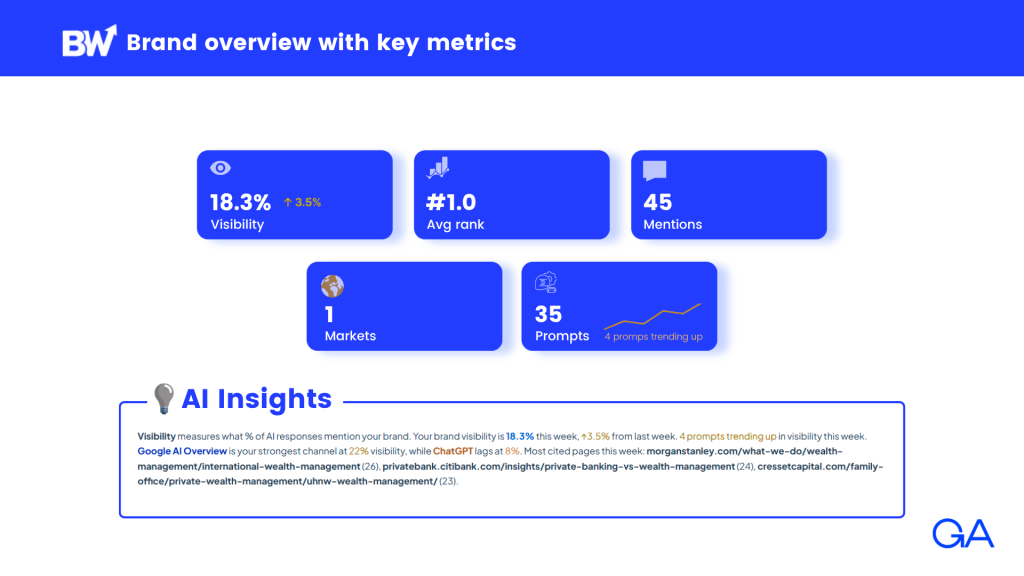
This automated approach enables comprehensive monitoring at scale, tracking hundreds of queries regularly and alerting you to changes in visibility.
- Competitive Benchmarking
Understanding your performance in isolation provides limited context. Track the same core metrics for 3-5 primary competitors to reveal whether visibility gaps are absolute or relative.
Competitive data also helps identify what’s working for rivals. If a competitor consistently appears for queries where you don’t, analyzing their content and topical authority reveals optimization opportunities.
- Platform-Specific Tracking
Different AI platforms operate differently. Google AI Overview relies heavily on Google’s search index. ChatGPT’s training data and retrieval mechanisms differ. Perplexity emphasizes real-time web search.
Track performance separately by platform rather than aggregating. This reveals where visibility is strongest, where gaps exist, and whether optimization efforts require platform-specific approaches.
Building an AI Visibility Measurement Framework
Effective tracking requires more than collecting metrics, it requires a structured framework connecting data to strategic priorities.
Define Priority Query Sets
Not all queries matter equally. Identify which queries and topics are most valuable to your business:
- High-intent purchase queries where your brand should be considered
- Product comparison queries where you compete directly
- Implementation queries where expertise signals authority
- Thought leadership topics where visibility builds credibility
Organize queries by category and intent, then prioritize based on business impact.
Establish Baselines
Before optimizing, establish baseline measurements. Where do you currently appear? How often? In what context? Relative to which competitors?
Baseline data provides the reference point for measuring improvement.
Set Measurable Goals
AI visibility goals should be specific and tied to business outcomes:
- Increase mention frequency for [category] queries by 40% over six months
- Achieve top-three positioning in 60% of product comparison responses
- Match or exceed primary competitor’s share of voice in ChatGPT
Goals create accountability and help prioritize optimization efforts.
Monitor Trends Over Time
Track core metrics monthly. Look for patterns: Are mentions increasing? Is sentiment improving? Are competitors gaining share of voice?
Trend analysis reveals when algorithm changes or platform updates affect visibility, allowing quick response.
Common Tracking Challenges
Inconsistent Responses
AI platforms don’t always generate identical responses to the same query. Address this by testing queries multiple times and focusing on trends rather than single data points.
Platform Access Limitations
Not all AI platforms provide APIs or allow automated testing. Manual testing remains necessary for some platforms. Focus measurement on platforms where data is accessible.
Attribution Complexity
Users research in AI platforms but convert elsewhere. Multi-touch attribution and customer surveys help fill gaps, but perfect attribution remains elusive.
Conclusion
Measuring brand visibility across AI platforms requires new metrics, new tools, and new ways of thinking about search performance. Traditional rankings no longer capture the full picture when significant research happens in conversational AI interfaces.
The most effective measurement frameworks track mentions, citations, share of voice, sentiment, topic coverage, and competitive positioning across multiple platforms. They establish baselines, set clear goals, monitor trends, and connect visibility to business outcomes.
At GA Agency, we help brands build AI visibility measurement frameworks using BuzzWatch and other tools to reveal performance across ChatGPT, Google AI Mode, Perplexity, and emerging platforms. Whether you’re beginning to track AI search or refining an existing approach, we focus on actionable metrics that inform optimization decisions and demonstrate business impact.
Need help measuring your brand’s AI platform performance? Contact our team for a consultation on AI visibility tracking and measurement strategy.

Article author

Chiara Riva
Business Development Assistant