
















For marketing teams, the appeal of generative AI is not difficult to understand. A first draft that once took an hour can now appear in seconds. One idea becomes ten headlines, five social posts and three alternative introductions before the morning coffee is finished. Content can be summarised, translated, reformatted and repurposed almost instantly.
That efficiency is real and pretending otherwise misses the point. The sharper question is:
Once every brand has access to the same tools, can efficiency itself still be a differentiator?
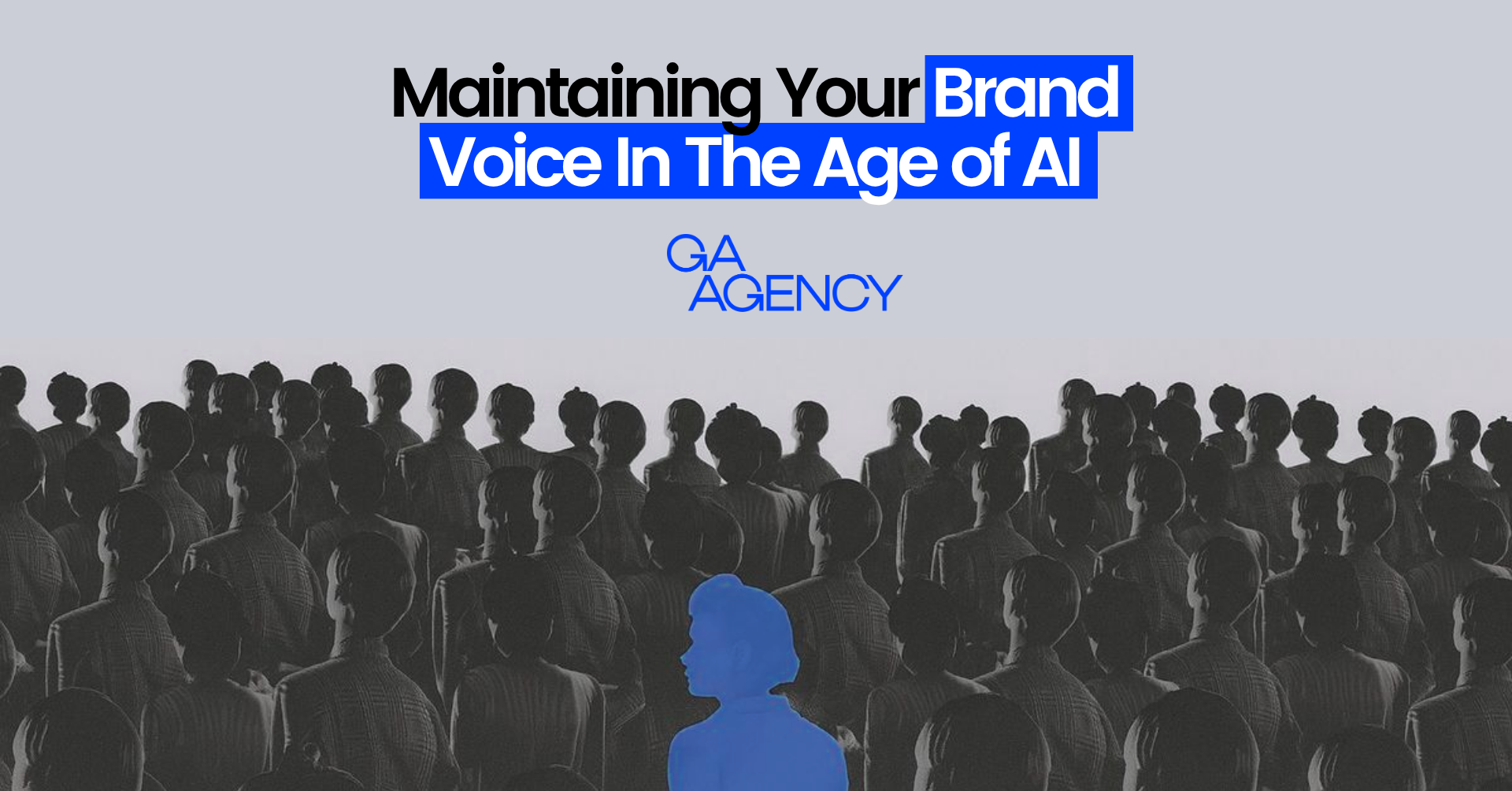
As generative AI becomes routine in marketing workflows, the conversation has moved from whether it should be used, to how to use it without losing what makes a brand recognisable in the first place. The greatest risk isn’t that AI produces bad content. It’s that it produces content that is perfectly acceptable but could have come from anyone. If every brand is special, none of them are.
When everyone optimises, everything starts sounding optimised
Generative AI is good at pattern recognition and plausible, polished output. Ask for a professional but engaging introduction and you’ll get something usable. Ask for ten alternatives and one will probably work. Ask for something clearer or shorter and it will likely save real editing time.
That utility is exactly the issue: most teams are reaching for the same tools, asking for the same qualities: engaging, authoritative, concise, persuasive, “friendly but professional”. Everyone is optimising towards similar technical requirements, similar formats, similar keywords. Under pressure to produce more, it becomes easy to accept the first output that’s simply good enough to publish.
Saving money on production only works if the content still gives someone a reason to choose you.
There’s early evidence of this trade-off in the research; a 2024 study in Science Advances gave writers access to generative AI for a creative writing task. Individually, the AI-assisted stories were judged more creative, better written and more enjoyable, with the biggest gains going to writers who’d scored lowest on creativity beforehand. But across the group, the stories became noticeably more similar to one another.
That’s the distinction that matters for brands. A tool can make any single piece of content better while still, at scale, pulling everyone’s output toward the same centre. Once competent content is easy for anyone to produce, competence stops being distinctive.
Your brand voice is not a prompt
Feeding AI a set of tone-of-voice guidelines helps, but it only solves part of the problem, because most guidelines aren’t as unique as they sound. “Friendly but professional,” “knowledgeable without being patronising,” “conversational and approachable” – hundreds of companies could describe themselves in exactly those words.
What actually makes a brand distinctive is harder to compress into four adjectives: the stories it tells, the opinions it’s willing to state, the jokes it would and wouldn’t make, the way its customers actually talk, the questions that keep coming up with sales and support, its read on a specific market and what that market needs.
The human element is the story
The case for human involvement doesn’t need to be sentimental: “machines aren’t creative, humans are authentic” is not a particularly useful argument. The practical case is simpler: people working closely with a brand have context an AI system doesn’t.
They have spoken to customers. They know why a product exists. They remember which campaign landed unexpectedly well in one market and fell flat in another. They can tell the difference between how customers actually talk and how a marketing deck talks. They can spot a cultural reference that’s technically correct but lands wrong.
A brand does not become distinctive because it publishes consistently. It becomes distinctive because people gradually associate it with particular ideas, experiences, opinions and ways of seeing its market. Those stories might come from why a product exists, what customers repeatedly struggle with, what a team has learned, what the company disagrees with in its industry or what it has seen first-hand in a particular market.
AI can help turn those stories into content. But it cannot manufacture the underlying experience that made the story worth telling in the first place.
Language can be generated. Context has to be understood. Machine translation is a useful comparison here: it has made progress and is genuinely useful for everyday tasks, but that hasn’t made specialist linguistic and cultural expertise redundant. When intention, nuance or positioning are on the line, automation and expertise still need to work together, not in place of each other.
Search is moving in the same direction
There is a practical SEO argument for differentiation too. Google’s current guidance for its AI-powered search experiences pushes publishers toward what it calls “non-commodity” content: material with genuine first-hand experience and a distinctive point of view. Google isn’t telling anyone to avoid AI tools (its own guidance acknowledges they’re useful for research and structuring) the concern is volume without added value.
That reframes a question people keep asking the wrong way. The debate around whether Google can “detect” AI writing is besides the point. The question worth asking is what the content actually contributes that wasn’t already out there. If the answer is nothing, changing the production method doesn’t fix it.
Consumers are part of the equation too
How audiences respond to AI-generated creatives is more complicated than “consumers hate AI”. Kantar’s 2026 research on GenAI in media and advertising found sentiment generally improving, though marketers remain well ahead of consumers in their enthusiasm (75% of marketers felt positive about generative AI, against 56% of consumers and the gap held on advertising specifically, where 63% of marketers said they felt excited compared with 51% of consumers).
Context seems to matter more than the technology itself. In the same research, 57% of consumers said they were concerned about fake or misleading AI-generated advertising, but quieter applications (content variations, localisation, resizing assets) barely registered as a concern. A separate experiment from the Nürnberg Institute for Market Decisions found something similar: identical adverts were judged more harshly on emotional grounds when participants were told the ad was AI-generated, even though nothing about the ad itself had changed and the effect varied by product and context.
There’s probably no universal “right” percentage of AI involvement in a piece of marketing. In this landscape, the question worth asking is whether the automation is strengthening the experience or quietly removing something the audience actually valued.
Give people a reason to choose you
Content marketing exists to give people a reason to notice a brand, remember it and choose it over the alternative. If every company in a category starts producing the same polished, correct, optimised content, that reason gets harder to find. When a market starts to sound like one indistinguishable chorus, customers have less reason to take a chance on anything unfamiliar. That is particularly risky for smaller and challenger brands. Established names already have awareness, distribution and years of brand memory working in their favour. Less familiar brands often need content precisely to create that recognition. Sounding like everyone else removes one of the few advantages they can actively build.
A brand leans on AI to cut production costs and, in doing so, quietly erodes the thing content was supposed to deliver in the first place: a reason to be chosen.
Automate execution, protect decisions
The more useful frame isn’t AI versus human. It’s execution versus decisions. Most execution work is a strong fit for AI assistance. Decisions about what a brand actually stands for are a different category of task: AI cannot make those decisions reliably on its own, because the information needed to make them often sits outside the model: in customer conversations, market history, internal knowledge and human judgement.
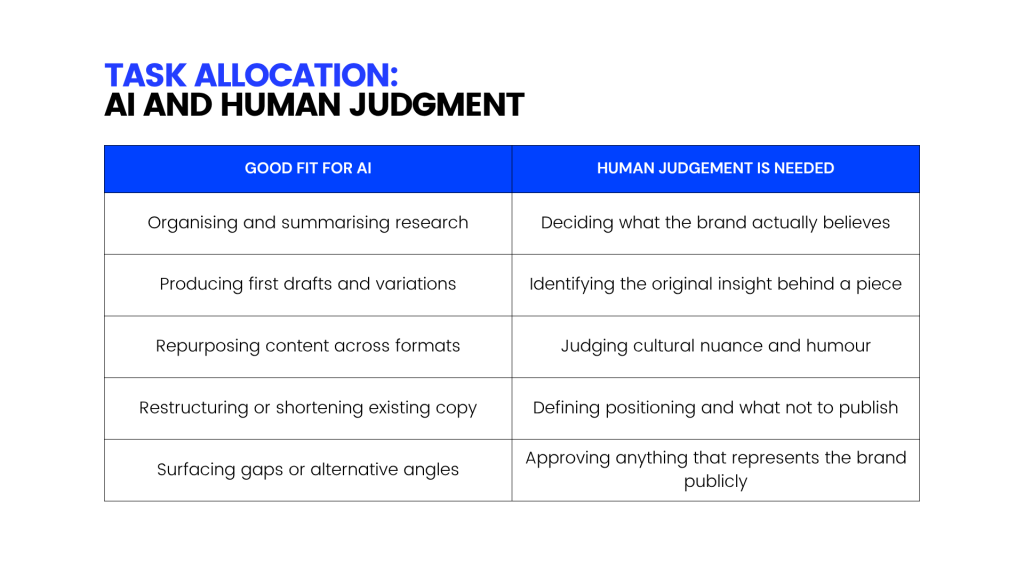
Used well, means giving AI better material and keeping the judgement calls in human hands, instead of eliminating it in the whole.
Distinctiveness is more valuable when content-making is easier
Generative AI isn’t going away from marketing workflows and there is no real reason it should. Used with intent, it removes genuine friction; what it changes is what counts as an advantage. When everyone can produce grammatically correct, well-structured, marketing-friendly content in minutes, competence alone stops being enough to stand out. The differentiators move elsewhere: to expertise, experience, taste, context, customer knowledge and the judgement to know which of those things are actually worth turning into content.
That has a direct implication for where the budget goes. Investment in AI production tools only pays off alongside investment in the people, context and market understanding that give that production something worth saying – the kind of understanding that tends to come from people who actually work inside a market, not just translate into it.
When everyone has access to the same technology, the more useful question may no longer be who can produce the most content, but who still has something distinctive to say.
Working out where that line sits for your brand is exactly the conversation worth having with us. ù
Sources:
Doshi, A. R. & Hauser, O. P. – “Generative AI enhances individual creativity but reduces the collective diversity of novel content”, Science Advances (2024).
Google Search Central – “Top ways to ensure your content performs well in Google’s AI experiences on Search” (2025).
Google Search Central – “Optimizing your website for generative AI features on Google Search”.
Google Search Central – “Google Search’s guidance on using generative AI content on your website”.
Kantar – “The state of GenAI in Media and advertising” (2026).
Nürnberg Institute for Market Decisions – “Transparency Without Trust: Consumer attitudes toward AI-generated marketing content”.

Article author

Daniela Montella
Senior Account Executive