


















The GEO discipline (structured data, entity authority, schema markup, citation optimisation) was conceived by English-speaking practitioners, stress-tested against English-language queries and validated against benchmarks that are themselves English-weighted by design. This is not a strategic oversight but an operational reality of how the discipline developed.
The problem is the assumption this history has baked into the standard GEO playbook: that the AI surfaces, retrieval architectures and cultural signals driving AI search in London or New York are the same ones driving it in Seoul, São Paulo or Milan. They are not. A January 2026 study from Cornell University found that LLMs built specifically for Indian languages still reason like Western ones, because language and cultural alignment are not the same problem. And for international brands, the gap between what a single global GEO programme can achieve and what is actually needed in each market is widening as regional AI ecosystems consolidate. It’s the visibility gap the industry isn’t talking about.
The AI platform map doesn’t look like the GEO strategy map
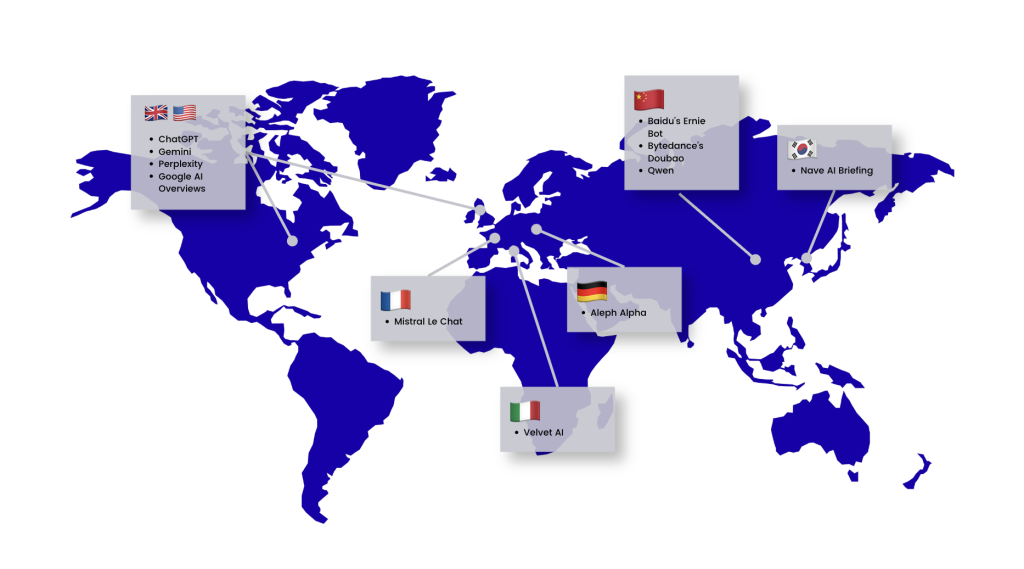
The conventional GEO playbook was built around a specific set of AI surfaces: ChatGPT, Gemini, Perplexity and Google AI Overviews. These dominate English-language markets. They do not dominate much of the rest of the world.
In China, ChatGPT and Gemini are not accessible. Baidu’s ERNIE Bot crossed 200 million monthly active users in January 2026, whilst ByteDance’s Doubao surpassed 100 million daily active users in December 2025. A brand’s English-optimised content architecture isn’t underperforming in this ecosystem. It simply does not exist there. South Korea tells a parallel story. Naver captured 62.86% of the South Korean search market in 2025 (more than double Google’s share) and has been rolling out AI Briefing. Naver routes results to internal properties rather than the open web. Structured data and schema markup designed for Google’s crawlers was never built to reach Naver’s retrieval layer.
The European picture is less dramatic in scale but equally consequential for brands with significant presence there. France secured €109 billion in private AI infrastructure investment commitments at the 2025 AI Action Summit and Mistral holds a three-year framework agreement with the French military, awarded in December 2025: signals of structural permanence, not a nascent experiment. Germany’s Aleph Alpha, backed by Bosch and SAP, trained multilingual models across five languages with EU regulatory compliance as a design principle – though the company is now in merger talks with Canada’s Cohere, signalling how fast this space is shifting. Italy now has Velvet AI, built specifically for Italian linguistic and cultural context. The OpenEuroLLM initiative, launched in 2025, is developing open models covering all 24 official EU languages. Each of these is a distinct retrieval ecosystem with its own signal hierarchy, one that a strategy optimised for ChatGPT doesn’t reach.
Why this matters for international brands
A single global programme produces a false picture
The default for most internationally operating brands is to treat GEO as one programme: one content architecture, one citation monitoring framework, measured in English. That produces a coherent report. It doesn’t produce an accurate picture of visibility across markets.
The audit question itself shifts when you move outside English-language AI surfaces. Query performance in English does not tell you much about how a brand surfaces in Korean inside Naver’s AI Briefing or in Italian inside a retrieval system trained on European corpora. These are not the same platforms. They don’t share the same retrieval logic and performance in one says nothing about performance in the others. A GEO programme that looks healthy globally may be invisible precisely where growth is coming from.
Translation doesn’t close the gap – and the reason is technical
The deeper issue lies in the embedding layer. AI retrieval works by encoding content as vectors, then measuring distance between those vectors and the vectors a user’s query generates. How accurately that match works depends entirely on how well the embedding model represents the language involved. Embedding models are not language-neutral.
The Llama 3.1 series (positioned at launch as state-of-the-art in multilingual performance) was trained on 15 trillion tokens, of which only 8% was categorised as multilingual content (per Meta’s published training data mix). Research published in May 2025 comparing English and Italian information retrieval found that while multilingual models bridge the general-domain gap reasonably well, performance consistency decreases substantially in specialised domains, precisely where most enterprise brands compete.
The failure mode is quiet rather than visible. Translated content doesn’t produce obvious errors. It produces silently degraded retrieval: content that should surface doesn’t, dashboards stay green and no signal flags the problem. The gap only becomes apparent when someone tests in the actual market language, using queries constructed by native speakers rather than translated from English.

Cultural authority signals don’t transfer with translation
Below the technical problem sits a harder-to-instrument one: cultural context shapes what an AI model treats as relevant in the first place. Research published in 2024 by Cornell University researchers found that when five GPT models were asked questions from a global cultural values survey, responses consistently aligned with the values of English-speaking and Protestant European countries – not because the models were asked to translate, but because their reasoning reflects the cultural composition of their training data.
The January 2026 Cornell study Fluent but Foreign extended this finding in a direction that should unsettle marketing teams who assumed regional models solve the regional problem. The researchers evaluated six LLMs built specifically for Indian languages and culture alongside six global models. The regional models showed no better cultural alignment with Indian values and practices than the global ones. Writing suggestions from both sets of models introduced Westernised or exoticised patterns into the output. Regional fine-tuning failed to recover alignment. The problem, the researchers concluded, lies in pretraining data: a model can speak a language fluently and still reason like a Western one.
The implication is direct. Building in the local language is a necessary condition for local AI visibility. The cultural authority signals that determine whether content clears a model’s relevance threshold (the institutional references, the community proof points, the professional register) have to be grounded in each market from the start. Translation achieves linguistic accuracy but it doesn’t produce cultural authority.
The same logic holds within English: American syntactic patterns read as subtly foreign to models trained predominantly on British or Irish corpora.
The cost of waiting is structural, not just tactical
The common response to this problem is to wait for the market to mature. Regional ecosystems will converge, tooling will improve and a coherent multilingual GEO practice will become easier to execute at scale. There is something to this. There is also a structural counter-argument.
Each of the regional ecosystems described above (Naver, Baidu, Mistral and others) is consolidating around its own training corpus. The longer a brand remains absent from those corpora, the harder it becomes to establish the parametric presence that drives citation. This is not a problem you can solve retrospectively. The brands building native cultural and linguistic presence in these markets now are accumulating an advantage that compounds; the gap between them and late movers widens as market-specific retrieval logic matures. The brands closest to closing this gap are the ones that build from inside each market: with native-language teams who understand what counts as authoritative there, not just what translates correctly.
If you’d like to understand where your brand currently stands across non-English AI surfaces, this is the conversation to have with us.
Sources
- Duane Forrester, ‘Your AI Visibility Strategy Doesn’t Work Outside English’, Search Engine Journal, April 2026 — https://www.searchenginejournal.com/your-ai-visibility-strategy-doesnt-work-outside-english/571742/
- Dhruv Agarwal et al., ‘Fluent but Foreign: Even Regional LLMs Lack Cultural Alignment’, Cornell University / Microsoft Research, arXiv 2505.21548, revised January 2026 — https://arxiv.org/abs/2505.21548
- Massive Multilingual Text Embedding Benchmark (MMTEB), ICLR 2025 — https://arxiv.org/html/2502.13595v3
- English vs Italian information retrieval performance, MDPI, May 2025 — https://www.mdpi.com/2504-2289/9/5/141
- GPT cultural bias research, Nature / Cornell University, 2024 — https://www.nature.com/articles/d41586-025-03891-y
- Baidu ERNIE Bot / Doubao / Qwen MAU data — Quest Mobile / KR-Asia, cited in Forrester (2026)
- Naver search market share 2025 — Digitimes, January 2026

Article author

Chiara Riva
Business Development Assistant