
















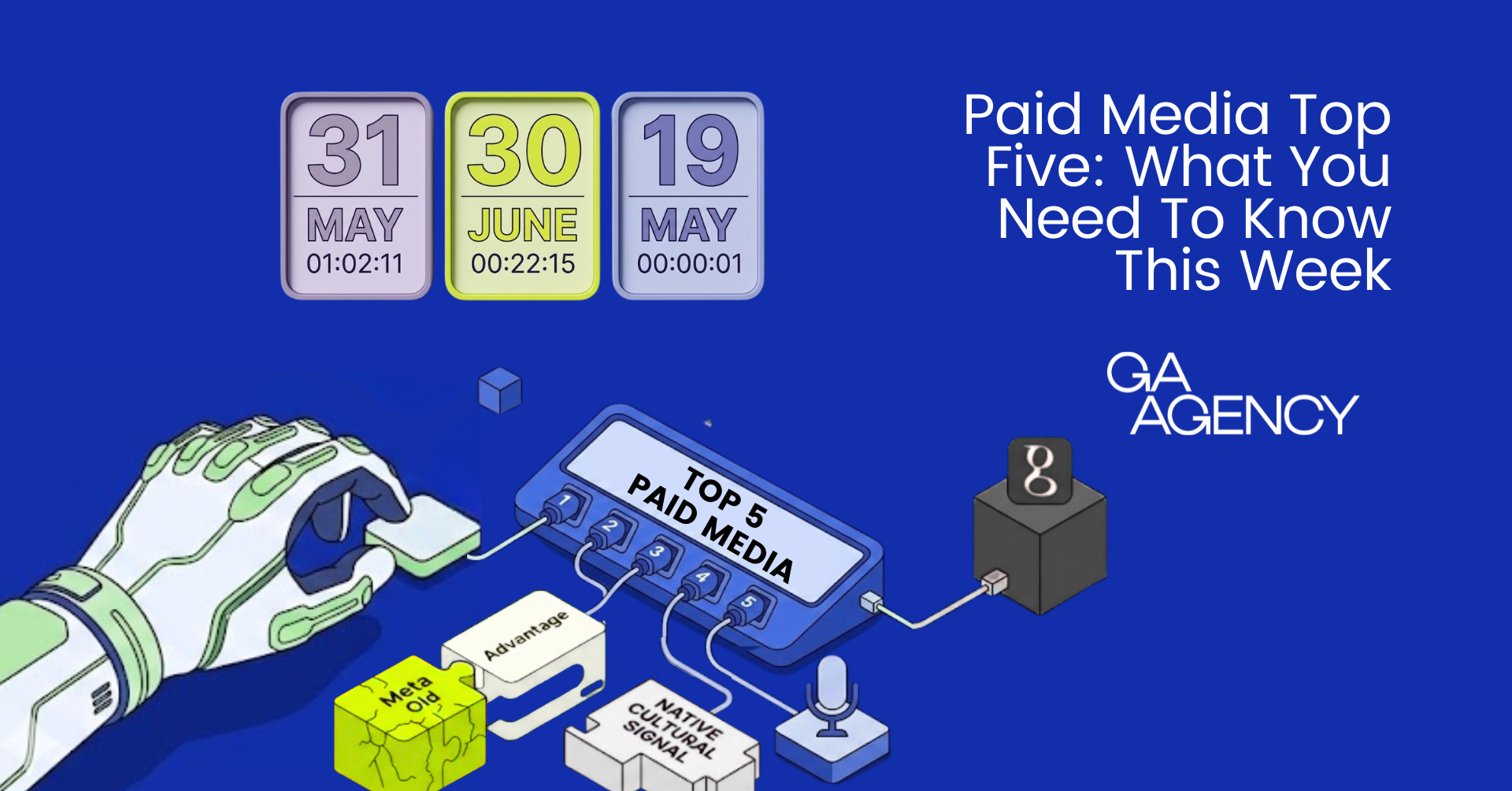
Five updates landed across Google Ads, Meta and OpenAI this week. They are unrelated in origin – one is a privacy policy change, one is a new ad channel, one is the quiet deprecation of a campaign type many teams are still running. What they share: each requires a deliberate decision before a specific date. Two have deadlines inside the next fortnight.
1. Google Ads is cutting granular historical data to 37 months – from 1st June
From 1st June 2026, hourly, daily and weekly reporting data will be limited at 37 months across the Google Ads interface, API, scripts, the Google Analytics Data API and the BigQuery Data Transfer Service. Monthly, quarterly and annual aggregates are unaffected. The announcement, made on 1 May via the Google Ads Developer Blog, reverses a November 2024 policy that had given advertisers an eleven-year window, a commitment that lasted less than eighteen months.
Why it matters
The risk is not the 37-month limit itself – for most accounts, that is sufficient. IInstead, the real challenge comes from the two specific ways this transition can impact your reporting. First, any account using longer baselines for seasonality modelling or year-on-year benchmarking loses data permanently after 1 June with no recovery option. Second, automated pipelines querying granular data via the API or BigQuery will silently return shorter windows from June without throwing an error. BigQuery users face an additional obstacle: a manual backfill requesting data beyond 37 months will overwrite existing records with null values.
What to do
Export granular performance history for any campaign where long, granular baselines matter before 31st May. Then audit every reporting pipeline that pulls daily or weekly data and confirm whether any query reaches beyond 37 months.
2. Google Ads will default all accounts to call recording from 1 July
From 1st July 2026, any account with no prior call recording selection will be automatically set to Yes. Google confirmed this via direct advertiser communications. The feature uses AI to assess whether recorded calls represent genuine qualified leads, replacing call duration as the primary conversion signal. It so far applies only to US and Canadian numbers. Healthcare and financial services accounts are excluded from the auto-enrolment.
Why it matters
The measurement improvement is real: AI-assessed intent filters out robocalls and misdials and feeds stronger signals into Smart Bidding. The compliance question is separate. A platform default does not satisfy the advertiser’s legal obligations – the brand’s own privacy notice must reflect that calls are recorded and shared with a third party. Brands in regulated sectors face the most immediate exposure, but the issue is not sector-specific.
What to do
Go to Admin → Account Settings → Call Ads → Call Recording and make an explicit selection before 30 June. Then check whether your privacy notice covers call recording and third-party data sharing before re-enabling.
3. ChatGPT’s self-serve ad platform is now open to all US businesses
On 5th May 2026, OpenAI opened a beta self-serve Ads Manager to all US advertisers. The $50,000 minimum spend from the original pilot has been removed. The platform now also supports cost-per-click bidding, with OpenAI recommending a starting CPC of $3–$5, alongside the existing CPM model. A Conversions API and site pixel are live, enabling post-click measurement of purchases, leads and sign-ups. Ads appear below ChatGPT responses, not within them and are visible only to Free and Go-tier users.
Why it matters
The barrier to entry has gone. Sources puts the overall ChatGPT ad click-through rate at 0.68%, with the best-performing brands at 1.57% – whilst these are only early figures from a new environment, the benchmarks are becoming more widely available. The Conversions API matters more than the CPC option in isolation: without conversion data, spend produces numbers but not learning. Note that OpenAI retains ownership of the pixel and issues it based on what you want to track, so this is not a fully open measurement environment.
What to do
Set up the Conversions API and pixel before spending. Define success criteria (CPA, assisted conversion contribution, new-to-brand share) before the campaign launches, not after. Test incrementally alongside existing search investment, not as a substitute for it.
4. ChatGPT ads are coming to the UK
On 7th May 2026, OpenAI confirmed it is expanding the ChatGPT ads pilot to the UK, Japan, South Korea, Brazil and Mexico “in the coming weeks”. The GDPR-compliant consent infrastructure was already embedded in the pixel before the announcement – technical groundwork typically laid ahead of market entry, not after. OpenAI is targeting $2.5 billion in ad revenue in 2026 and $100 billion by 2030.
Why it matters
For brands absorbing sustained acquisition cost pressure on Meta and Google, this is a rare first-mover opportunity. ChatGPT’s ad environment is structurally different: users are actively researching and comparing, not passively scrolling. The brands that build competency before the platform becomes crowded benefit from lower competition costs.
One implication worth noting for multi-market brands: organic AI authority and paid visibility are not fully separate on this platform. ChatGPT surfaces brands with depth and consistency across its training data. Acquisition budgets alone will not substitute for that.
What to do
Register interest at openai.com/advertisers. Start building GEO and AEO foundations in parallel: brands already well-cited inside AI surfaces will have a structural advantage when paid inventory opens. Finally, define your attribution framework before launch: traffic from ChatGPT frequently registers as direct in standard analytics tools.
5. Meta is deprecating Advantage+ Shopping and App Campaigns on 19th May
From 19th May 2026, creation, duplication and editing of Advantage+ Shopping Campaigns (ASC) and Advantage+ App Campaigns (AAC) will no longer be possible across any version of Meta’s Marketing API. This is a hard enforcement date, confirmed in Meta’s February 2026 release notes. Campaigns must migrate to Meta’s unified Advantage+ structure.
Why it matters
The most consequential operational change is the removal of the existing customer budget percentage field. The replacement is a two-ad-set approach, which requires rebuilding audience definitions, exclusions and budget logic from scratch. That takes time the deadline no longer provides if migration has not started. Any automated workflow or third-party tool built on legacy ASC or AAC API paths will also break on 19 May.
What to do
Audit every workflow touching ASC or AAC campaign creation, editing or duplication before 19 May. Migrate existing campaigns using migrate to advantage plus to preserve campaign IDs and data continuity.
Five updates, five decisions – landing simultaneously on teams already running full capacity. Managing API deprecations, default opt-ins and new channel evaluations at the same time is hard. If it would help to have a specialist team audit your account structure or handle these migrations before the deadlines hit, get in touch.

Article author

Chiara Riva
Business Development Assistant