
















In a bold move that may reshape how users engage with search, Google has officially launched its long-anticipated AI Mode to all users in the United States. Initially accessible only via Search Labs, AI Mode now appears as a standalone tab under the familiar Google search bar. This development, unveiled at Google I/O 2025, signals a fundamental shift in search behaviour and presents a major opportunity — and challenge — for digital marketers.
As Google reimagines its search experience, understanding how AI Mode works and what it means for SEO, content marketing, and eCommerce is critical for staying competitive.
A More Conversational, Intelligent Search
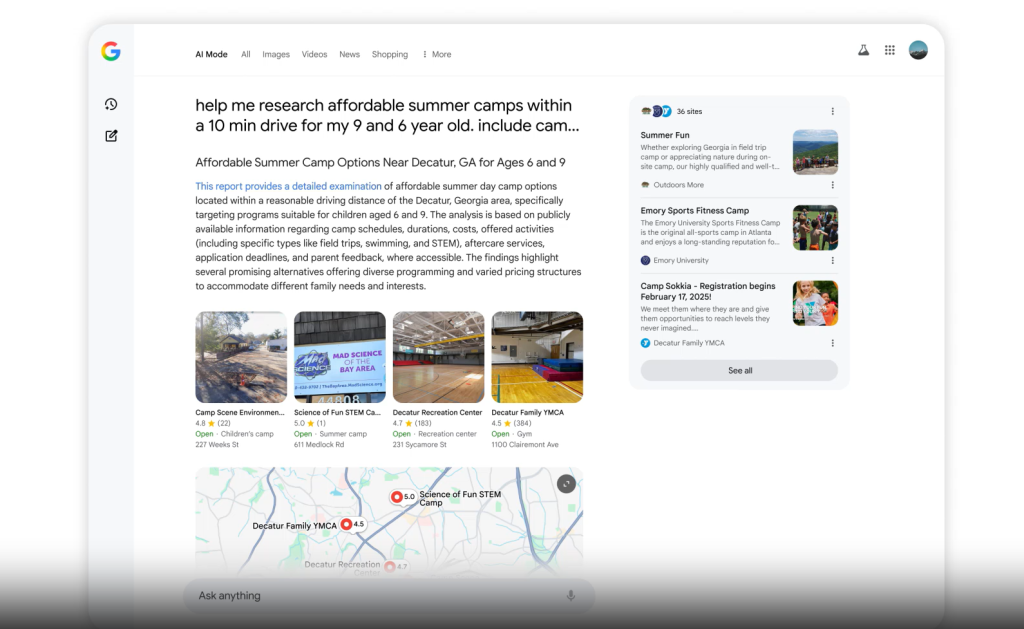
AI Mode marks an evolution of the search engine paradigm. While traditional Google searches typically yield a list of links, AI Mode aims to act more like a smart research assistant.
According to Google CEO Sundar Pichai, AI Mode prompts searchers to ask richer, more detailed questions — often two to five times longer than traditional queries. That’s because users are no longer constrained to short keywords; they’re invited to explore topics more conversationally, which reflects the broader shift toward natural language interactions powered by generative AI.
Deep Search: Like a Research Analyst at Your Fingertips
One of the most powerful features within AI Mode is Deep Search. Think of it as a turbocharged search mechanism that breaks down your query into subtopics, runs hundreds of parallel searches, and synthesises the results into a comprehensive, fully cited summary.
For marketers, this has dual implications. On one hand, it raises the bar for content quality — Google will now be citing top-tier, deeply informative content within these AI-generated summaries. On the other hand, brands that invest in high-quality, authoritative content stand to benefit from increased visibility in these curated overviews.
If your blog posts, whitepapers, or product guides offer genuine value, AI Mode could be a significant traffic driver.
Complex Analysis & Real-Time Data
Rolling out soon via Search Labs, AI Mode’s complex analysis feature introduces dynamic data visualisations generated in real-time using Google’s Knowledge Graph. This will initially support finance and sports queries, offering charts and stats without the need to visit multiple websites.
While that could reduce click-throughs in certain verticals, it also opens the door for data-rich content to be showcased more prominently. Marketers working in finance, SaaS, or sports media should prioritise structured data and API integrations to remain competitive.
From Browsing to Buying: Agentic Checkout & Shopping AI
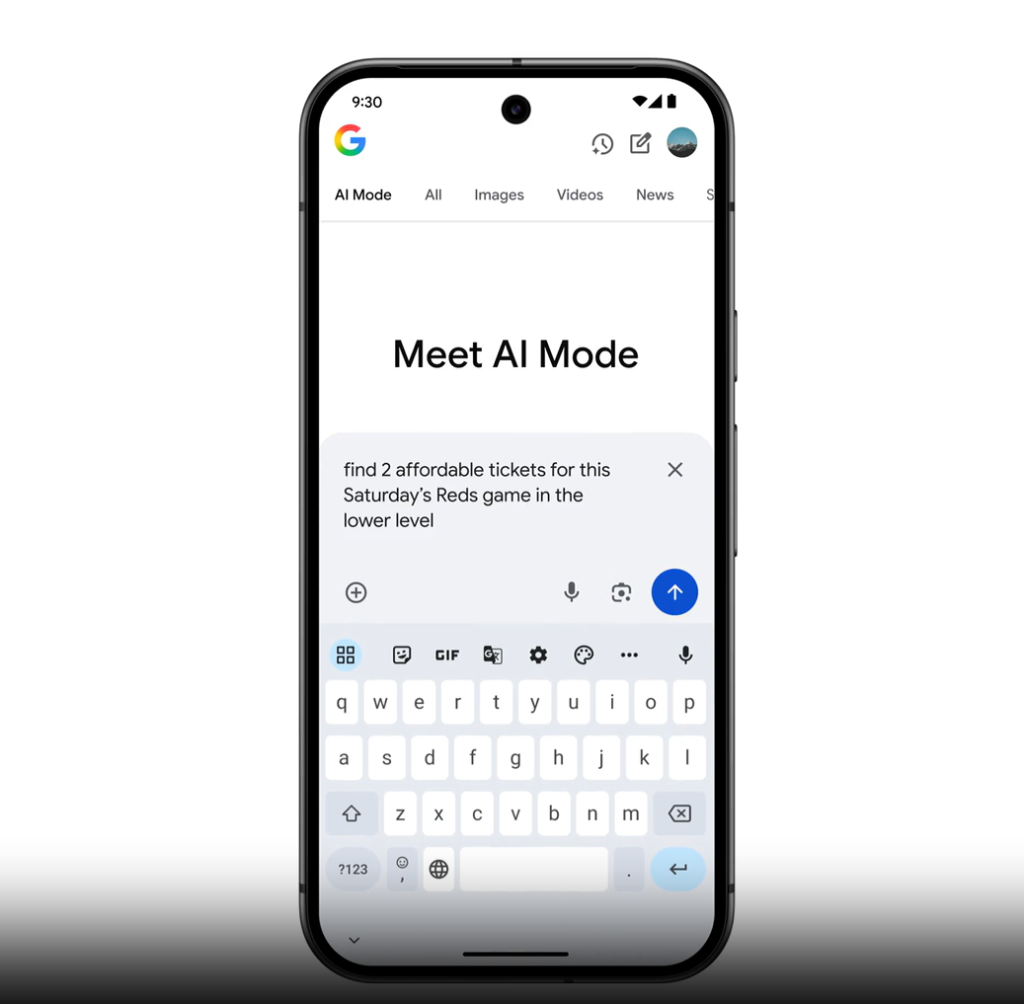
Google is also making AI Mode transactional. New capabilities like Agentic Checkout and Shopping in AI Mode allow users to shop, compare, and even start the checkout process—all without leaving the search interface.
For example, a query like “find two affordable tickets for this Saturday’s Reds game” triggers AI Mode to scan multiple ticket sites in real time, analyse pricing, and even autofill forms — leaving only the final “buy” click to the user.
This streamlining of the purchase journey is potentially transformative for eCommerce and local businesses. However, it also means brands must ensure their product feeds, inventory data, and schema markup are flawless. Any friction in the customer journey, and Google may simply favour competitors with better data hygiene.
Personal Context: Hyper-Relevance via Google Integration
Google is bringing personal data into the mix with Personal Context — an opt-in feature that allows AI Mode to incorporate Gmail, Calendar, and other Google services. For example, if you’re planning a weekend in Nashville with foodie friends, AI Mode can suggest restaurants based on past bookings, show events near your hotel, and tailor recommendations to your preferences.
This level of contextual awareness redefines personalisation. For marketers, it underscores the importance of localised SEO, user behaviour data, and structured content that can be easily integrated into personalised AI outputs.
Gemini 2.5: Powering the New Search Experience
All of this is built on Google’s new custom model, Gemini 2.5, which powers both AI Mode and AI Overviews. Unlike earlier models, Gemini 2.5 handles multimodal inputs (text, images, code) with greater nuance and speed. This means AI Mode can better interpret ambiguous queries and return more relevant, diverse responses.
In practice, Gemini’s capabilities mean AI Mode can understand product reviews, extract key insights from videos, or analyse tables from PDFs — all in one query.
What This Means for Digital Marketing
AI Mode is not just a new tab — it’s a paradigm shift in how users access information and how brands must position themselves. Here are a few key takeaways for digital marketers:
- Content quality matters more than ever. Thin content won’t cut it. You need in-depth, expert-level articles that AI Mode will want to cite.
- Structured data is your friend. Whether it’s product listings, local business info, or financial data, having clean, machine-readable markup is essential.
- SEO is evolving. Traditional keyword targeting must give way to semantic understanding and topic authority.
- Prepare for zero-click searches. AI Mode answers many questions directly. Your strategy must evolve to focus on brand visibility, authority, and downstream conversions.
- Conversion paths are shortening. With shopping, reservations, and other tasks handled within the search experience, optimising for micro-conversions is critical.
Final Thoughts
Google’s AI Mode represents both a challenge and an opportunity. For businesses that embrace this new search experience, there’s enormous potential to reach users in a more intelligent, contextual, and effective way.
As with all major shifts in the digital landscape, success depends on staying agile, testing aggressively, and doubling down on value-driven content and experiences.
Welcome to the future of search — it’s deeper, smarter, and more personal than ever.

Article author

Chiara Riva
Business Development Assistant