
















ConvertMate’s 2026 GEO Benchmark – analysing 12,500+ queries across 8,000 domains – found that just 6.82% of ChatGPT citations overlap with Google’s top 10 and that 28.3% of ChatGPT’s most-cited pages rank nowhere on Google. AI Overviews now trigger on approximately 48% of all tracked queries, up 58% year-on-year (BrightEdge, February 2026).
The gap between where your brand ranks on Google and where it appears in AI-generated answers is not a technical oversight. It is a structural difference – and for most brands, it is widening. When a user queries ChatGPT or Perplexity, the model does not return a ranked list of pages. It runs query fan-out – breaking the query into sub-searches, pulling content through Retrieval-Augmented Generation (RAG) and synthesising a single answer that cites a small number of sources. The model’s question is not ‘which page ranks?’ but ‘which source can I trust?’
What AI engines actually evaluate
The factors AI engines use to decide who to cite are different from what drives Google rankings. They centre on three broad questions: how clearly is this brand understood and trusted as an authority in its category? Can this content be extracted and used directly? And has this brand been validated by sources the model already trusts?
Answering all three well requires a different kind of investment from traditional SEO, that spans content architecture, editorial strategy, third-party presence and brand consistency across channels. The brands visible in AI search today are the ones that started building these signals before most of their competitors recognised them as relevant. Entity authority, in particular, compounds over time: the further behind a brand falls now, the harder the ground it will have to make up.
How the six factors weight across platforms
The six factors apply universally, but each engine has distinct preferences.
| ChatGPT | Perplexity | Google AI Overviews | Claude |
| Leans on established entity recognition and institutional authority.Harder and slower for newer brands to break into citation sets.Rewards depth and long-standing credibility over recency. | Favours freshness and community-driven content.More accessible for brands that build presence in active industry discussions.Structured, comparison-style content performs particularly well. | Correlates more closely with traditional search performance than any other platform.Strong SEO foundations remain relevant here.E-E-A-T signals and multi-format content carry significant weight. | Rewards technical depth and primary research over aggregator content.Prioritises comprehensive, well-evidenced writing.Depth over breadth, consistently. |
Optimising for one platform may underperform across the others. The foundations (entity authority, content structure and earned third-party presence) are what build visibility across all four.
Ten steps to build AI search visibility
1. Establish your AI visibility baseline. Before investing, understand where your brand currently appears in AI-generated answers.
2. Audit how AI engines describe your brand. AI models form a view of your brand from your wider digital footprint. If that view is incomplete or inconsistent, you will probably not be cited.
3. Identify the sources AI trusts in your category. Different engines draw from different source types. Knowing which publications, communities and platforms carry authority in your sector is the starting point.
4. Map where competitors appear and you do not. AI search operates on a winner-takes-all logic at the response level. Where competitors are being cited and you are not is your clearest signal of where strategic investment is needed.
5. Assess whether your content is structured for AI extraction. Content built for engagement metrics alone often does not earn citations – content that is clearly organized most probably will.
6. Build presence in the sources that carry weight with AI engines. Third-party coverage, industry publications, professional communities and review platforms carry more weight than brand-owned content.
7. Ensure your brand’s positioning is consistent across channels. AI engines look for consensus. Inconsistent messaging reduces your credibility.
8. Treat content freshness as an ongoing priority. AI engines penalise stale content more quickly than traditional search. A content maintenance strategy is as important as a content creation strategy.
9. Confirm the technical foundations are in place. There are prerequisites that determine whether AI engines can access your content at all. Without them, investment in content and presence will not translate into visibility.
10. Build measurement that captures AI-sourced performance. AI search performance is largely invisible in standard analytics. ConvertMate’s 2026 benchmark puts AI-sourced traffic conversion at 4.4x that of standard organic – but only teams with the right measurement framework will be able to see it, let alone act on it.
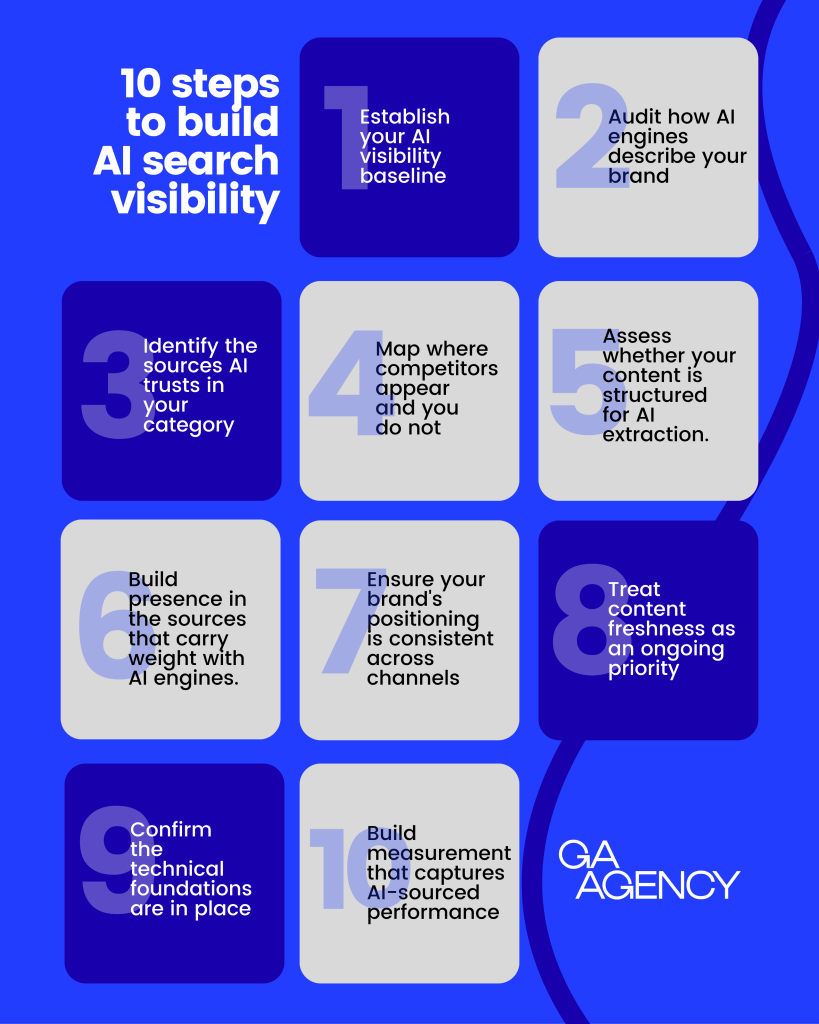
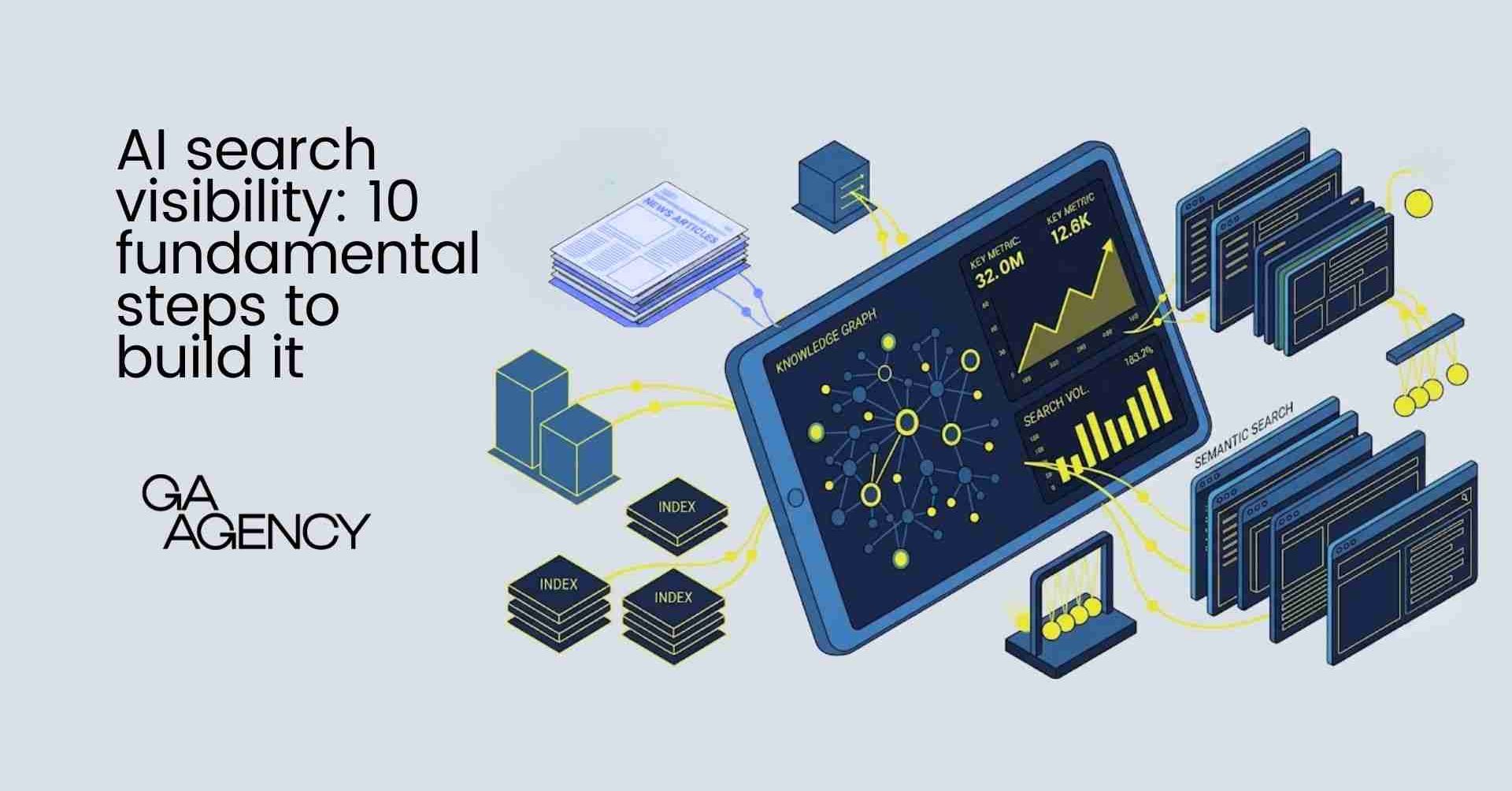
AI search visibility: 10 fundamental steps to build it
Most brands are entering 2026 with an AI search visibility gap they cannot yet measure. The good news is that the competitive window is still open – the brands that act now will be significantly harder to displace by the time this becomes a priority for everyone else.
If you would like to understand where your brand currently stands in AI search and what it would take to close the gap, get in touch with our team.
Sources
- GetMint, AI Search Ranking Factors: What Actually Determines Citations in 2026, February 2026
- ConvertMate, GEO Benchmark Study 2026, March 2026
- BrightEdge, AI Overviews One-Year Presence Analysis, February 2026 (via ConvertMate)
- Growth Memo, long-form content citation analysis, 2026 (via ConvertMate)
- Foundation Marketing, GEO citation analysis, March 2026 (via ConvertMate)
- SE Ranking, AI search citation analysis, November 2025 (via Position Digital)
- Semrush, 9 Steps to Get Ahead in AI Search 2026 (infographic)

Article author

Chiara Riva
Business Development Assistant