
















On 15th May 2026, Google published its first official guide to optimising for generative AI features on Google Search. The guide covers AI Overviews, AI Mode and the infrastructure emerging behind both. It matters less for any surprises it contains and more for what it confirms, and, predictably, for what it leaves out.
Google’s position: GEO is SEO
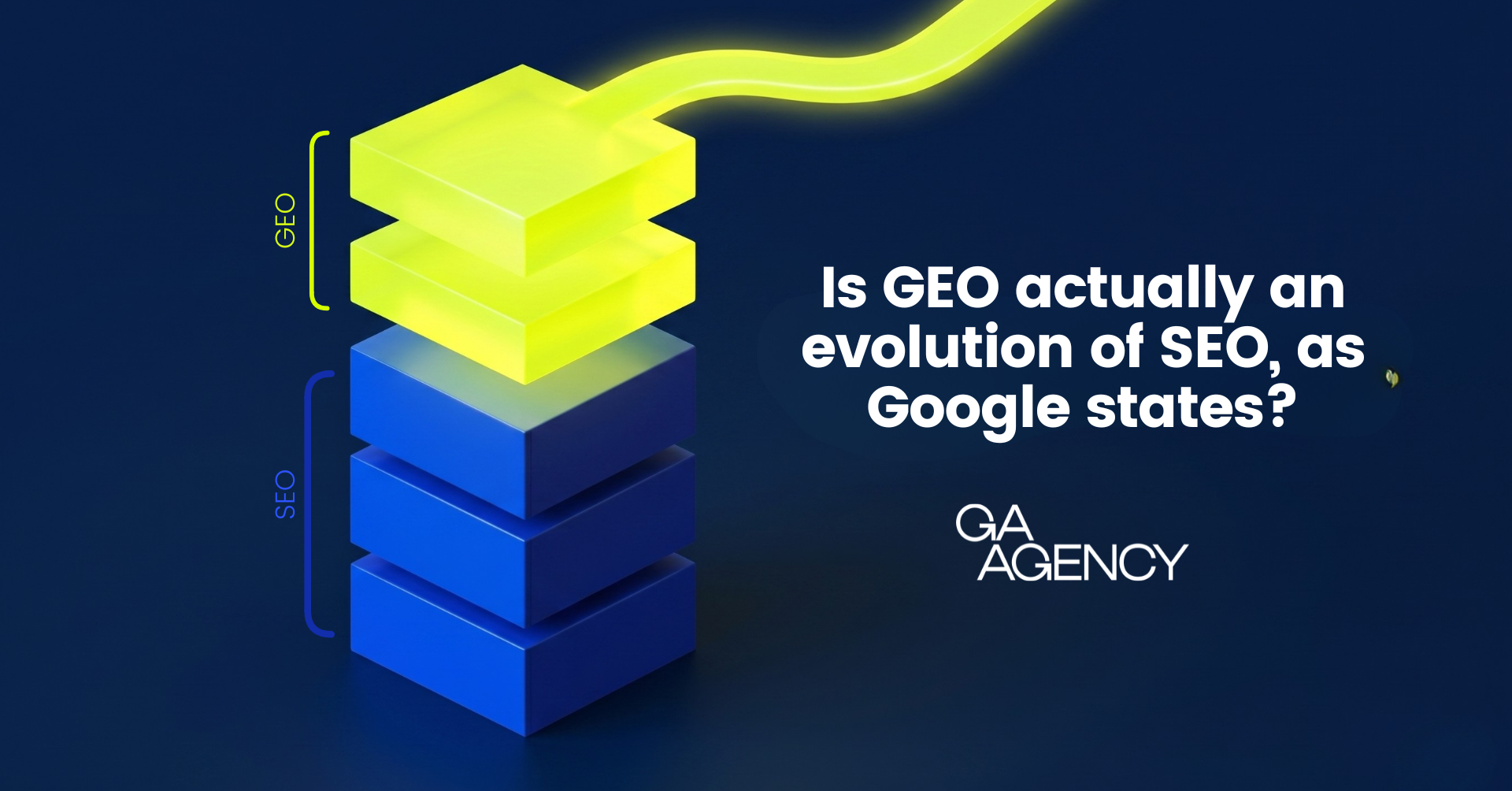
The most important point in the entire document is a matter of definition: from Google’s perspective, optimising for generative AI search is optimising for the search experience and therefore still SEO. GEO and AEO, the guide notes, “are useful shorthand for work focused specifically on AI search experiences”. However, the underlying work (building crawlable, authoritative, well-structured content) is, in Google’s framing, “the same work it has always been”.
On the foundations, we agree. We’ve said from the start of the AI search conversation that GEO is what SEO becomes when the search surface is generative. Brands that treated organic search as a long-term investment, rather than a series of tactical responses to algorithm updates, are the ones best positioned for it. GEO is the next stage of SEO, rather than a separate discipline sitting alongside it. Brands that maintained strong SEO foundations aren’t starting from zero.
Reading Google’s documentation carefully
That said, Google’s official guidance has always had a specific function: to articulate the public-facing baseline while omitting tactics it cannot or will not formally endorse. Link building and guest posting are the obvious historical examples. These practices have been officially discouraged by Google since the late 1990s and continue to sit at the centre of almost every credible SEO programme operating today. The pattern is consistent: official guidance tells you what’s safe to say out loud, not what consistently moves the needle.
The same logic applies to this new GEO guidance. There is genuinely useful information in the document, and we’ll come to it. But reading it as the complete playbook for AI visibility is reading it the way Google would prefer, not the way the data actually behaves.
What Google does say, that holds up
Three points in the guide are accurate and worth restating:
- Non-commodity content with a genuine point of view. AI systems cite expert, first-hand perspectives over restated industry-standard information. A page that summarises what five competitors already say, or that could have been produced by a generative model, will not be cited. We saw this clearly in a recent luxury fashion audit: rewriting category editorial around the brand’s buyers’ actual decision-making process, like the questions they ask or the comparisons they make, improved citation presence in AI Overviews. The differentiator wasn’t volume; it was specificity that couldn’t be replicated.
- Technical foundations, unchanged. Crawlability, indexation and rendering remain entry-level requirements. JavaScript-heavy storefronts that don’t render cleanly for bots are out of the conversation before it starts.
- Product and local data completeness. Merchant Center feeds and Google Business Profiles are increasingly the route into AI commerce surfaces. Feed completeness is a direct visibility lever.
In our view, Google correctly debunks LLMs.txt and AI-specific markup, too. There is no evidence that standalone AI-specific files materially affect citation and the budget spent on them is better repurposed to content quality and feed completeness.
The agentic web is coming: is your site architecture ready?
The section of the guide that has received the least attention is on agentic experiences. Browser agents (AI systems that navigate websites autonomously to compare product specifications, book reservations or complete purchases) are moving from experimental to operational. The guide notes these agents gather data by analysing visual renderings, inspecting DOM structures and interpreting the accessibility tree. Protocols like the Universal Commerce Protocol (UCP) are emerging to let search agents take direct action on merchant sites.
The implication: your site’s architecture will either enable or block an AI from completing a purchase on a user’s behalf. Navigating this requires a working understanding of the full stack: how a page is read by an agent, where friction is introduced and how to resolve it without rebuilding the brand experience from scratch. For lean marketing teams, this is the moment to translate your visual brand into agent-friendly infrastructure, before it becomes a competitive disadvantage.
What we are doing across client portfolios, beyond Google’s guide
Across the accounts we run in the luxury fashion, travel and real estate industries, alongside several e-commerce at scale websites, we have been tracking citation patterns in AI Overviews, ChatGPT and Perplexity for over a year with our proprietary tool Buzzwatch. The strategies that consistently shift citation share are not always the ones Google’s guide foregrounds. They include:
- Structuring content the way LLMs actually parse it. Google’s guide dismisses chunking. In practice, pages with clear semantic structure, well-defined sub-sections and answer-format passages positioned early are cited materially more often.
- Brand presence strategy beyond traditional link building. Manufactured mentions are spam, and Google is right to treat them as such. But genuine third-party presence like editorial coverage, expert citations, or inclusion in authoritative comparative content, correlates more strongly with AI citation than with traditional rankings. In AI search, being talked about by the right sources is a more direct visibility lever than it was in classical organic.
- Optimising for the citation, not just the click. AI surfaces reward content written to be quoted. That is a different craft from content written to convert a click. Both need to coexist on the same page, structured so the AI can extract the citation-worthy passage without forcing the human reader through it.
- Market-by-market specificity for international brands. Translated content that achieves linguistic accuracy but flattens cultural nuance performs no better in AI surfaces than it did in traditional search. Ensuring a website answers the native users’ intent is an essential activity, something we detailed previously in our guide GEO was built in English. Most of your markets aren’t.
GA’s position
Two things can be true at once.
- Yes, doing good SEO means building the foundations for GEO. Brands with strong organic discipline did not have to rebuild their approach when AI Overviews arrived or AI Mode launched. The foundations were in place and Google’s guide confirms that.
- But also, there is an enhanced strategy layer required to compete in AI surfaces, one that goes beyond what Google publicly endorses and is grounded in how LLMs actually read, structure and cite content. That layer is where the differentiated work is happening and it is what our 50+ SEO specialists have been trained to deliver across client portfolios for the past two years.
If you want to understand where your brand stands against these benchmarks, our 10-step AI optimisation framework is a practical place to start.
Sources Google Search Central. Optimising your website for generative AI features on Google Search (15th May 2026): https://developers.google.com/search/docs/fundamentals/ai-optimization-guide

Article author

Chiara Riva
Business Development Assistant